
TL;DR

Get smart everyday buys delivered free with Prime
- Fast, free delivery on millions of items
- Prime Video, Amazon Music and more included
- Member-only deals all year
Anthropic’s $65 billion Series H isn’t just about money — it’s a calculated push for control over AI compute resources. The company’s rapidly growing revenue signals strong demand for its models, making this a strategic infrastructure investment as much as a funding round.
When a startup hits a near-$1 trillion valuation, it’s tempting to think it’s all about hype. But behind the headlines, Anthropic’s latest funding round reveals a different story. This isn’t just a giant check for a shiny new valuation — it’s a calculated move to lock in the AI infrastructure that will power the next wave of innovation.
Think of it like building a highway network — the real value isn’t just the tolls you collect, but the roads you control. Anthropic’s $65 billion raise is a bet on its access to the crucial compute capacity that will determine who leads in AI’s future. This article breaks down what this massive funding really means, and why compute capacity is now the foundation of AI dominance.
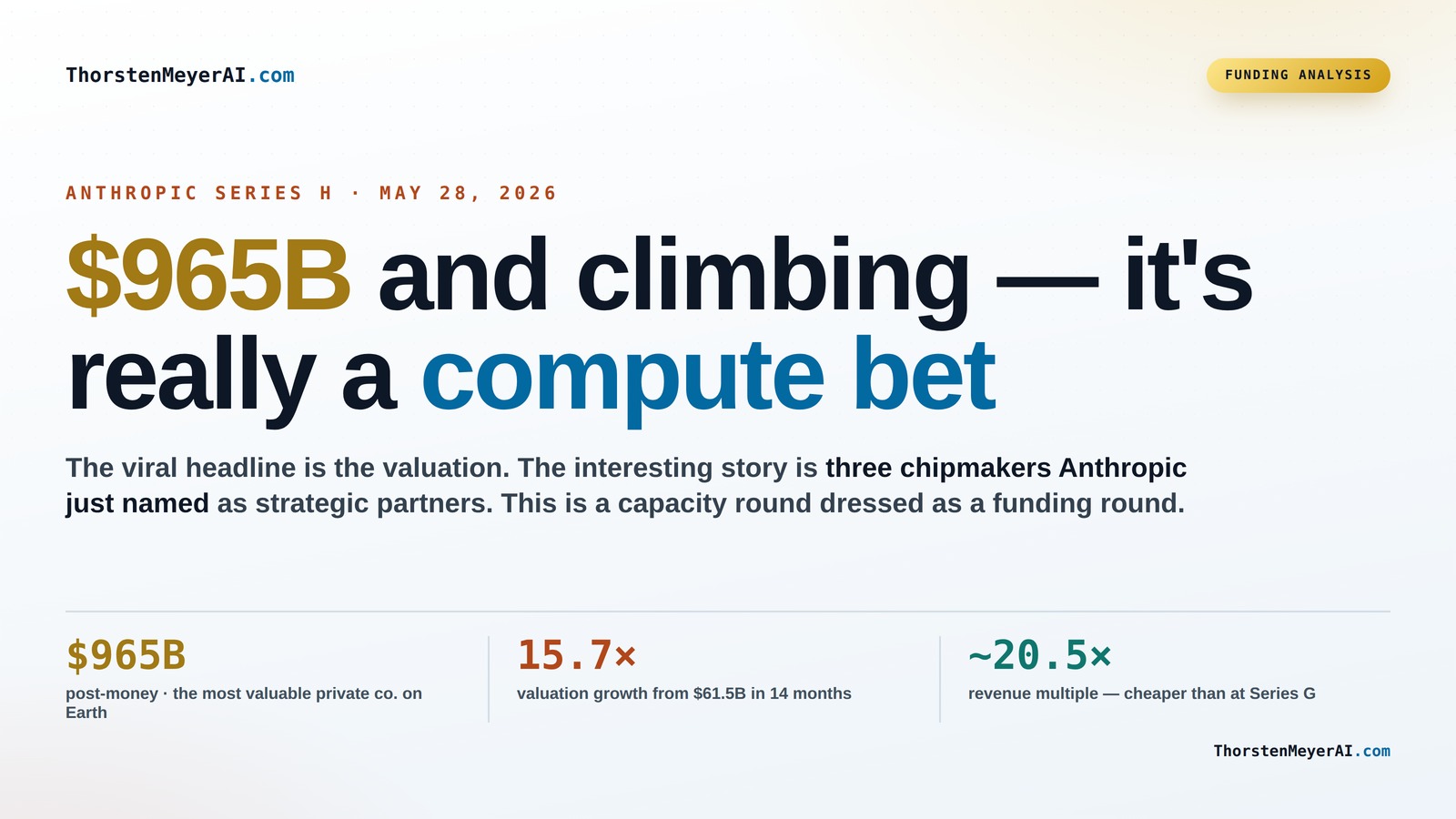
$965B and climbing — it’s really a compute bet
The viral headline is the valuation. The interesting story is in the press release’s middle paragraphs — and in three chipmakers Anthropic just named as strategic partners. This is a capacity round dressed as a funding round.
The numbers nobody can quite parse in sequence
Read together they describe a trajectory with no precedent in enterprise software. Read individually, each looks like a typo.
From $61.5B to $965B in fourteen months
Salesforce took roughly two decades to reach revenue numbers Anthropic just blew past. The sequence below is the part most coverage skips — it’s not the size, it’s the shape.
Anthropic’s valuation ladder · Mar 2025 → May 2026
Five rounds, fourteen months. Bar height is the valuation; the climb itself is the story. Tap any milestone for context.
The multiple actually got cheaper
Bubbles look like multiples expanding while revenue lags. Anthropic’s pattern is the inverse — the valuation tripled, but revenue grew faster, and the multiple compressed.
Revenue-to-valuation multiple · Series G → Series H
Same company, three months apart. The denominator (revenue) is outrunning the numerator (valuation) — exactly the opposite of what a bubble narrative predicts.
10+ gigawatts and three chipmakers
When you name Micron, Samsung & SK hynix alongside your equity backers, you’re saying the binding constraint isn’t demand or model quality — it’s the physical supply of memory chips. The Series H is a capacity round.
Compute commitments backing Anthropic’s capacity bet
$200B+ in announced compute spend across multi-year contracts. The $65B Series H raise has to be read against that bill, not against operating losses.
A genuinely durable bet — or a structural exposure?
Both readings can be true at once. The answer arrives over the next 18–24 months as the gigawatts come online and either fill with paying demand or don’t.
Revenue growth has no precedent in B2B software ($1B → $47B in 17 months). The multiple is compressing, not expanding. Claude is the only frontier model on all 3 major clouds. Enterprise AI spend share went from ~10% to >65% in a year. Compute commitments are tied to specific contracts with capacity dates.
20× revenue is not cheap by any historical software-investing standard. Revenue is reported gross of cloud-reseller pass-throughs, which inflates the top line. Profitability is 2 years out. Amodei’s own warning: a 12-month delay in AI progress “would make him bankrupt” — the compute commitments are a structural exposure to demand persistence.
The valuation race — and the IPO context
Anthropic shipped Opus 4.8 the same morning as Series H — not a coincidence. One week after OpenAI filed confidentially for IPO. The late-2026 frame is set: two frontier AI companies racing to public markets, each pitching durability.
Key Takeaways
- Anthropic’s $965 billion valuation is driven more by its strategy to secure AI compute capacity than by current revenue alone.
- The company’s commitments to over 10 gigawatts of GPU capacity signal a major move to control the infrastructure behind AI’s future.
- Rapid revenue growth, especially from Claude, justifies the push for more compute, reflecting soaring demand.
- Investors see infrastructure as the new battleground for AI dominance, with control over chips and data centers offering a strategic edge.
- Safety and interpretability are embedded into infrastructure investments, shaping the next era of trustworthy AI.
AI compute infrastructure hardware
As an affiliate, we earn on qualifying purchases.
As an affiliate, we earn on qualifying purchases.
Why a $965 Billion Valuation Is Really a Compute Power Play
Anthropic’s eye-popping valuation isn’t just a number — it’s a reflection of how much the company is betting on access to AI compute. The real story isn’t just about revenue; it’s about who controls the infrastructure needed to train and run the most advanced models. Imagine owning the roads that all the fastest cars need to reach their destinations — that’s what controlling compute capacity means.
For example, Anthropic’s recent commitments from chipmakers like Micron, Samsung, and SK hynix show it’s investing heavily in the chips that will fuel its models. This isn’t a typical funding round where money goes into hiring or marketing. It’s a strategic move to secure the raw materials — the GPUs and data centers — that will shape the AI landscape for years. The implications are profound: controlling this infrastructure could mean the difference between leading the AI race or falling behind, as access to compute becomes the ultimate bottleneck. Companies that secure capacity early will have the advantage of faster iteration, safer models, and the ability to handle larger datasets, all of which translate into market power and potential dominance.

high performance AI training servers
As an affiliate, we earn on qualifying purchases.
As an affiliate, we earn on qualifying purchases.
The Real Power: Massive Compute Commitments and Capacity Scaling
Anthropic’s press release mentions over 10 gigawatts of compute commitments — enough to power thousands of the world’s largest AI models. To put that into perspective, the entire current global GPU supply is roughly 20 gigawatts. This means Anthropic is aiming for nearly half of the entire GPU capacity — a clear signal that access to compute is now a strategic bottleneck.
Picture a scenario where your company owns the majority of the world’s fastest chips. That control lets you train models faster, more cheaply, and with more safety features baked in. This isn’t just about scaling up; it’s about setting the terms of the AI development landscape. The more compute capacity you control, the more you can influence model safety, bias mitigation, and deployment speed. These factors are critical, especially as AI models become more complex and resource-intensive. The tradeoff? Heavy investment in infrastructure can divert resources from pure innovation to capacity building, but it’s a necessary step to stay competitive in a race where raw power translates directly into strategic advantage.

As an affiliate, we earn on qualifying purchases.
Revenue Growth and Demand for Claude: The Market’s Growing Appetite
Anthropic’s revenue is exploding. From about $9 billion at the end of 2025, it’s now on track for over $30 billion in just a few months. That’s a 3.3x increase in less than six months. Demand for Claude, their flagship AI assistant, is skyrocketing — especially in enterprise markets.
Imagine a giant corporation deploying Claude across all its customer service channels, saving millions in operational costs. This rapid growth reflects a fundamental shift: AI is becoming essential infrastructure for business operations. The soaring demand justifies the push for more compute capacity — because without the right infrastructure, scaling these models quickly and safely is impossible. For investors and strategists, this growth signals that the market’s appetite for AI solutions is not only real but accelerating, making infrastructure investments more critical than ever to capitalize on this trend. The key takeaway? Rapid revenue growth isn’t just a sign of market acceptance; it’s a call to action to secure the resources needed to support ongoing expansion and innovation.

As an affiliate, we earn on qualifying purchases.
How Anthropic Will Use the $65 Billion — Building the Future Infrastructure
The $65 billion isn’t just for salaries or marketing. It’s primarily allocated to expanding compute infrastructure, safety research, and scaling product deployment. Think of it like pouring concrete and wiring for a new data city — the infrastructure that will host tomorrow’s models.
Anthropic plans to build new data centers, deepen relationships with chipmakers, and push safety features like interpretability. These investments aren’t just about increasing capacity; they’re about creating a resilient, trustworthy foundation for AI. The strategic value here is clear: by investing heavily in infrastructure and safety, Anthropic aims to differentiate itself in a crowded field where trustworthiness and safety are becoming as important as raw power. The tradeoff involves balancing immediate growth with long-term stability, but the payoff could be establishing a dominant position in the AI ecosystem, where control over infrastructure equates to market influence.

What the Valuation Says About the Future of AI Market Power
A near-trillion valuation indicates that investors are betting on Anthropic as a central platform in AI — not just a startup. They see a future where control over compute capacity translates directly into market dominance. It’s like owning the oil fields or the power grid, now in the digital age.
This high valuation also reflects expectations of widespread enterprise adoption, increased model demand, and the importance of AI safety and interpretability — which are now core to infrastructure investments. The implications are significant: companies that secure infrastructure early will have a competitive advantage, influencing the pace and nature of AI development. This valuation signals a shift from viewing AI as just software to understanding it as a hardware and infrastructure-dependent industry, where control over physical assets becomes a key strategic asset.

The AI Infrastructure Race: Who’s Gaining the Most Ground?
Anthropic’s focus on GPU supply is part of a larger race. Google, OpenAI, Meta, and Microsoft are all vying for the same scarce compute resources. The difference now? Control over this capacity could determine who leads in AI breakthroughs.
For instance, a recent partnership with Nvidia means Anthropic might get priority access to the latest GPUs, giving it a competitive edge in training larger, safer models faster than peers. This race is not just about acquiring capacity but about securing reliable, scalable, and exclusive access to the most advanced hardware. The ability to lock in supply and influence the development cycle could mean the difference between leading the next wave of AI innovation or falling behind. Strategic decisions made now—such as forming exclusive partnerships—will shape the future landscape of AI dominance.

Safety and Interpretability: The Hidden Edge in the Compute Race
Investors are also betting on safety and interpretability — making AI models not just powerful but trustworthy. Anthropic’s capstone is that safe, explainable AI models will dominate enterprise markets, with infrastructure as the backbone.
Think of safety as the sturdy foundation of a skyscraper — without it, the whole structure risks collapse. This focus might be what sets Anthropic apart as the AI race pivots toward trustworthy applications. By investing heavily in interpretability tools and safety research, the company aims to embed trustworthiness into its models, which is increasingly demanded by regulators, enterprises, and end-users. The tradeoff involves balancing rapid deployment with thorough safety measures, but the strategic implication is clear: trust is becoming a critical component of AI infrastructure, and those who master it will set the standards for enterprise adoption.
Frequently Asked Questions
Why is this round described as ‘really a compute’ story?
Because the core of the investment isn’t just about valuation or revenue — it’s about securing massive GPU capacity and infrastructure that will determine who leads in AI development for years to come.How can Anthropic justify a $965B valuation?
The valuation reflects expectations of dominant market position, control over AI infrastructure, and the rapid growth in demand for their models like Claude, rather than just current revenue figures.What exactly will the $65 billion be used for?
Primarily for building data centers, securing chip supply, advancing safety and interpretability research, and scaling infrastructure to support larger, safer models.How much revenue does Anthropic generate now?
Anthropic is on track for over $30 billion in annualized revenue, with explosive growth driven by rising demand for Claude in enterprise markets.Does this signal a bubble, or a real infrastructure race?
While valuations are high, the focus on securing physical compute resources suggests a genuine race for infrastructure dominance, not just speculative hype.Conclusion
This isn’t just a funding round — it’s a strategic infrastructure play. Anthropic is betting everything on control over the compute needed to train and run the next generation of AI models.
In a landscape where the race for AI supremacy hinges on raw capacity, control of infrastructure is the new power. If you’re watching the AI world, this shift from hype to hardware is where the real action is.

Halloween Picks
halloween
As an affiliate, we earn on qualifying purchases.