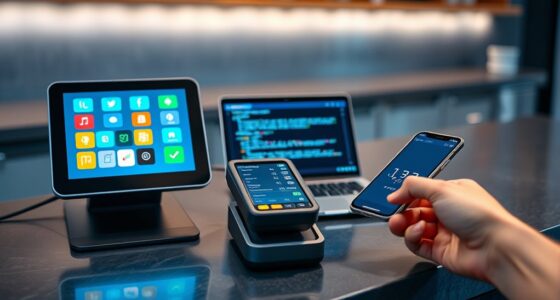
A Merchant Identification Number (MID) is like a digital fingerprint that links your transactions to your business, ensuring payments are accurate and secure. It plays a key role in processing sales, detecting fraud, and organizing sales data by location or channel. MIDs help prevent errors, flag suspicious activity, and streamline your financial management. If you want to understand how MIDs protect your business and improve your payment systems, there’s more to discover ahead.
Key Takeaways
- MIDs uniquely identify businesses in payment systems, linking transactions to the correct bank accounts.
- They are essential for accurate transaction routing and processing in both online and point-of-sale environments.
- MIDs help detect and prevent fraud by monitoring suspicious activity and transaction patterns.
- Different locations or sales channels often have separate MIDs for detailed control and reporting.
- Proper use of MIDs ensures secure, efficient fund transfers and improves operational insights.
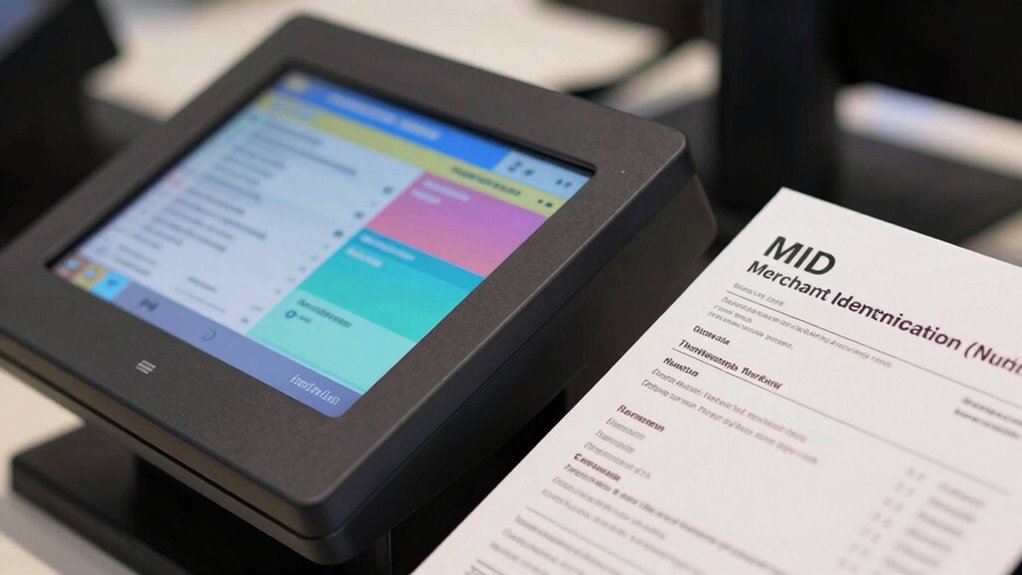
Have you ever wondered how businesses are uniquely identified during financial transactions? It’s all thanks to Merchant Identification Numbers, or MIDs. These numbers serve as a digital fingerprint for your business in the world of payment processing. When you process a sale, the MID links that transaction to your specific business account, guaranteeing the money moves correctly and securely. This identification isn’t just a convenience; it’s essential for transaction processing efficiency and fraud prevention. Without a unique MID, it would be difficult to track sales, reconcile accounts, or detect suspicious activity.
Merchant IDs are essential for secure, accurate transaction tracking and fraud prevention in payment processing.
In the domain of transaction processing, the MID acts as a key component. Every time a customer makes a payment, the transaction data is routed through the payment gateway and associated with your MID. This process helps guarantee seamless and accurate handling of payments, reducing errors and delays. It also streamlines record-keeping, making it easier to generate reports and analyze sales trends. Because each MID is tied to your business’s bank account, it plays an integral role in guaranteeing funds are deposited correctly and swiftly. Without it, processing payments becomes chaotic, increasing the risk of misrouted funds or rejected transactions. Additionally, the use of MIDs can help you optimize your payment processing workflows and improve overall operational efficiency. Incorporating security features linked to your MID can further enhance your fraud prevention measures.
Fraud prevention is another essential reason why MIDs matter so much. When you have a unique identifier for your business, it becomes easier for payment processors and banks to monitor transactions for signs of suspicious activity. Unusual patterns or transactions that don’t align with your typical sales can be flagged more quickly, helping you catch potential fraud early. If your business is targeted by fraudulent transactions, having a clear MID makes it easier to dispute charges and resolve issues with the payment processor. It also allows for better security measures, such as setting limits or monitoring transaction types, which protect both you and your customers. Additionally, understanding the role of MIDs in fraud detection can help you better safeguard your business. Recognizing how MIDs contribute to security measures can further enhance your fraud prevention strategies.
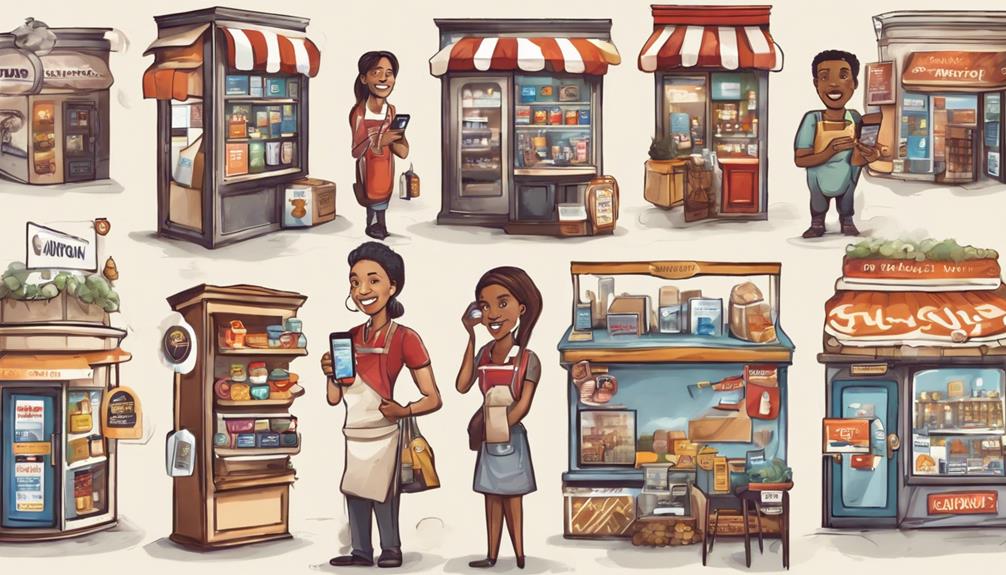
You’ll find MIDs used in various scenarios—whether you’re setting up a new point-of-sale system, integrating online payment platforms, or managing multiple outlets. Each location or sales channel often has its own MID, giving you detailed control over your transactions. This segmentation helps with fraud prevention, since suspicious activity can be isolated to specific locations. It also makes reporting more precise, so you can see exactly where your sales are coming from. In essence, your Merchant Identification Number isn’t just a string of digits; it’s an indispensable tool that safeguards your business, ensures smooth transaction processing, and enhances your ability to prevent fraud. Additionally, understanding the role of MIDs in digital content and research can help you better navigate the evolving landscape of online commerce.
merchant identification number (MID) scanner
As an affiliate, we earn on qualifying purchases.
As an affiliate, we earn on qualifying purchases.
Frequently Asked Questions
How Are Merchant Identification Numbers Assigned?
Merchant identification numbers are assigned during the merchant verification process, where payment processors or banks verify your business credentials. They generate a unique ID to guarantee ID security and prevent fraud. You won’t typically assign this number yourself; instead, it’s issued after successful verification. This ID helps streamline transactions, monitor activity, and protect both you and your customers, making secure payments more efficient and trustworthy.
Can a Merchant Have Multiple Identification Numbers?
Yes, a merchant can have multiple identification numbers. About 30% of large merchants maintain more than one ID for different locations or payment channels, enhancing security and streamlining ID verification. This helps protect merchant accounts and customer data. Having multiple IDs allows merchants to isolate transactions, improve merchant security, and manage various business segments efficiently, ensuring smoother operations and reducing the risk of fraud or account breaches.
Are Merchant IDS the Same Across Different Payment Processors?
No, merchant IDs aren’t the same across different payment processors. Each processor assigns its unique merchant ID, which helps guarantee merchant ID security and proper transaction routing. When you undergo merchant ID updates, it’s essential to notify each processor separately because these updates don’t transfer automatically. Always verify your merchant IDs with each processor to avoid confusion or security issues, and keep your merchant ID security protocols up to date.
How Do I Find My Merchant Identification Number?
You find your merchant identification number (MID) by logging into your merchant account or payment gateway dashboard. Interestingly, over 80% of merchants overlook this step, risking payment issues. Usually, the MID appears under account details or settings. If you’re unsure, contact your payment processor’s support team. Your MID is essential for processing payments smoothly and is often required for account verification or troubleshooting within your payment gateway.
Do Merchant IDS Affect Transaction Fees?
Yes, merchant IDs can affect transaction fees because they help guarantee merchant security and accurate transaction tracking. When your merchant ID is properly set up, payment processors can verify transactions quickly, which often leads to lower fees. Conversely, if your merchant ID isn’t correctly linked, it might cause delays or higher costs. So, maintaining a secure, well-tracked merchant ID benefits both your transaction efficiency and fee management.
payment gateway security device
As an affiliate, we earn on qualifying purchases.
As an affiliate, we earn on qualifying purchases.
Conclusion
So, next time you see that Merchant Identification Number, remember it’s not just a string of digits—it’s your secret handshake with the financial world. Without it, you’re basically invisible, like a ghost in the transaction machine. So keep it safe, keep it secret, and maybe, just maybe, don’t forget who you are when the money starts talking. Because in the end, that tiny number holds all the power—and all the secrets you’d rather keep hidden.
POS transaction tracking system
As an affiliate, we earn on qualifying purchases.
As an affiliate, we earn on qualifying purchases.

Fraud Auditing Using CAATT: A Manual for Auditors and Forensic Accountants to Detect Organizational Fraud (Security, Audit and Leadership Series)
As an affiliate, we earn on qualifying purchases.
As an affiliate, we earn on qualifying purchases.