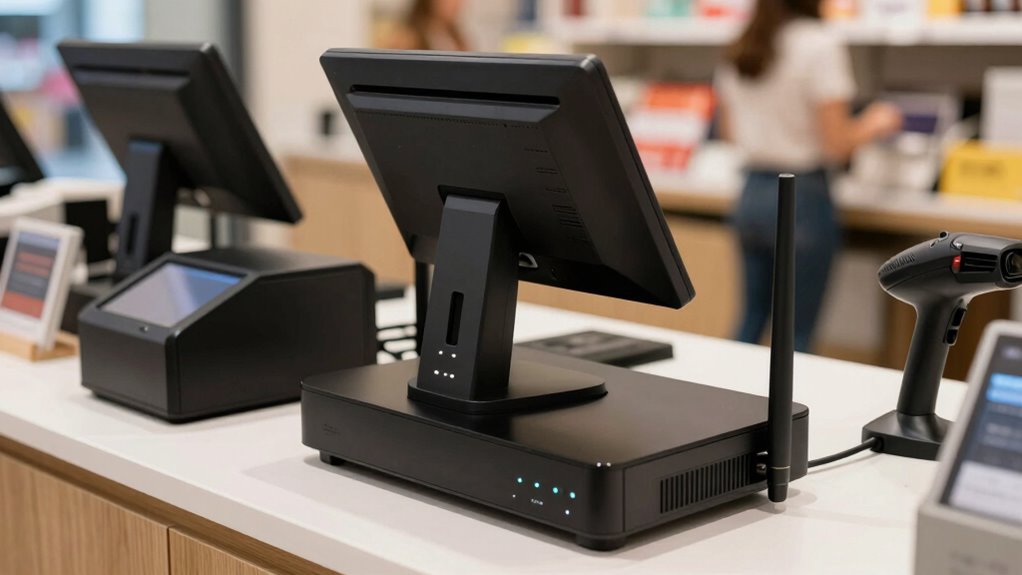

When selecting an LTE router for POS redundancy, reliability and failover capabilities are king. The KuWFi 4G LTE Router stands out for its unlocked flexibility, making it ideal for businesses that need adaptable solutions. The Teltonika RUT951 excels in industrial environments thanks to its dual SIM support and rugged build. However, tradeoffs in cost, complexity, and configuration can challenge users—especially those new to LTE networking. Keep reading to explore each option and find the best fit for your POS setup.
Key Takeaways
- Top picks balance between ease of use and advanced failover features.
- Industrial-grade routers like the Teltonika RUT951 excel in harsh environments but come at a higher price.
- Unlocked SIM card slots provide flexibility but require more configuration knowledge.
- Outdoor models like the Cudy Outdoor are resilient but may have limited internal features.
- Price and feature set often trade off: more robust routers tend to cost more but offer better reliability.
| KuWFi 4G LTE Router with SIM Card Slot, Unlocked WiFi Router |  | Best Overall for Versatile Small Office Connectivity | Connectivity Technology: Wi-Fi | Wireless Compatibility: 802.11n | Wi-Fi Generation: Wi-Fi 4 | VIEW ON AMAZON | See Our Full Breakdown |
| N300 WiFi Unlocked 4G LTE Modem Router with SIM Card Slot |  | Best Value for Stable 4G LTE Backup | Carrier Compatibility: Major carriers | Download Speed: 150Mbps | Wi-Fi Speed: 300Mbps | VIEW ON AMAZON | See Our Full Breakdown |
| Teltonika RUT951 Industrial 4G LTE Router with Dual SIM, Wi-Fi & Ethernet |  | Best for Harsh Environments with Failover Redundancy | Dual SIM: Yes | Wi-Fi: Yes | Ethernet ports: Multiple | VIEW ON AMAZON | See Our Full Breakdown |
| Cudy Outdoor 4G LTE AC1200 Wi-Fi Router, IP65, PoE, LT500 Outdoor |  | Best for Outdoor Large-Scale Coverage | Max Download Speed: 150 Mbps | Wi-Fi Generation: Wi-Fi 5 | Antenna Type: Retractable | VIEW ON AMAZON | See Our Full Breakdown |
| 4G VPN Router, Industrial LTE Router Yeacomm YF325 WiFi Modem Unlocked with Dual SIM Slots, RS232, External Antenna |  | Best for Rugged Industrial VPN Connectivity | Dual SIM Slots: Yes | VPN Support: Yes | LTE Bands: Multiple | VIEW ON AMAZON | See Our Full Breakdown |
| Cudy 4G Cat 4 AC1200 Wi-Fi 5 Router with 4 Ethernet Ports |  | Best for Small-Scale POS Redundancy in Rural or Backup Environments | Connectivity: 4G LTE Cat 4 | Wi-Fi: Dual-Band Wi-Fi 5 (867+300 Mbps) | Ethernet Ports: 4 Fast Ethernet ports | VIEW ON AMAZON | See Our Full Breakdown |
| lte router for pos redundancy | Ethernet Ports |
|---|---|
| KuWFi 4G LTE Router with SIM C | — |
| N300 WiFi Unlocked 4G LTE Mode | 4 |
| Teltonika RUT951 Industrial 4G | Multiple |
| Cudy Outdoor 4G LTE AC1200 Wi- | — |
| 4G VPN Router | — |
| Cudy 4G Cat 4 AC1200 Wi-Fi 5 R | 4 Fast Ethernet ports |
More Details on Our Top Picks
KuWFi 4G LTE Router with SIM Card Slot, Unlocked WiFi Router
The KuWFi 4G LTE Router stands out for its combination of high device capacity and flexible connectivity options, making it a solid choice for small offices needing reliable POS redundancy. Unlike the Teltonika RUT951, which excels in industrial environments, KuWFi offers a more straightforward setup for business use with support for up to 32 devices—ideal for busy retail locations. It features external antennas for broader coverage, but its data transfer rate caps at 300 Mbps, falling short for high-bandwidth demands. Its security protocols, primarily WPA2, are basic, so advanced enterprises might find this insufficient. While it provides wired and wireless links, the need for external antennas means additional setup effort. Best suited for small businesses that need a dependable LTE backup with simple management, but not ideal for high-traffic, bandwidth-intensive POS systems.
Pros:- Supports up to 32 user devices simultaneously
- External antennas extend coverage effectively
- Multiple security protocols for basic network safety
- Flexible wired and wireless connectivity
Cons:- Limited maximum data transfer rate for high-bandwidth tasks
- Basic security protocols may not suffice for sensitive data
- External antennas required for optimal coverage
Best for: Small retail stores or offices requiring reliable LTE backup for multiple POS devices
Not ideal for: High-volume retail environments needing ultra-fast data throughput or advanced security protocols
- Connectivity Technology:Wi-Fi
- Wireless Compatibility:802.11n
- Wi-Fi Generation:Wi-Fi 4
- Frequency Band:Single-Band
- Antenna Type:Retractable
- Number of Ports:5
Our verdict“This router is best for small to medium businesses seeking an easy-to-manage LTE backup with decent coverage and device support.”
N300 WiFi Unlocked 4G LTE Modem Router with SIM Card Slot
The N300 LTE Router delivers a straightforward, cost-effective solution for backup internet, supporting major carriers with speeds up to 150 Mbps. Compared to the KuWFi model, which offers broader device support, the N300 is simpler and better suited for environments where basic LTE connectivity suffices. Its dual-band Wi-Fi and four high-gain antennas extend coverage, but its maximum speed of 300 Mbps may be limiting for demanding POS systems. Security features like WPA3 add a layer of protection, yet it lacks advanced VPN options found in more enterprise-oriented options like the Yeacomm YF325. Setup is quick, making it attractive for small businesses or remote locations needing a reliable LTE failover. Best for small businesses or remote sites that prioritize affordability and ease of use over high-speed throughput or ruggedness.
Pros:- Supports major LTE carriers with reliable speeds
- Dual-band Wi-Fi extends coverage
- Plug-and-play setup for quick deployment
- Supports WPA3 security
Cons:- Limited to 4G LTE speeds, no 5G support
- No built-in battery or portable option
- Basic security features may not meet strict enterprise needs
Best for: Small businesses or remote locations needing an affordable LTE backup with simple setup
Not ideal for: High-traffic retail outlets with high-speed data needs or advanced security requirements
- Carrier Compatibility:Major carriers
- Download Speed:150Mbps
- Wi-Fi Speed:300Mbps
- Ethernet Ports:4
- Security Features:WPA3
- Antenna:4 high-gain antennas
Our verdict“This router offers a reliable, budget-friendly LTE backup for small-scale and remote POS setups, but isn’t suited for high-demand environments.”
Teltonika RUT951 Industrial 4G LTE Router with Dual SIM, Wi-Fi & Ethernet
The Teltonika RUT951 is tailored for industrial applications where uninterrupted connectivity is critical, thanks to dual SIM support for failover and rugged construction. Unlike the consumer-focused KuWFi or the outdoor Cudy router, the RUT951’s durability and remote management capabilities make it ideal for remote monitoring and industrial automation. Its complex setup and advanced VPN features might overwhelm non-technical users, but in harsh environments, its reliability outweighs this. It’s less suitable for small retail outlets that don’t need industrial-grade robustness, but for facilities where uptime is paramount, this router provides a peace of mind that others lack. Best for industrial or remote sites requiring high uptime and rugged build.
Pros:- Dual SIM support for failover ensures continuous uptime
- Rugged, durable design withstands harsh conditions
- Supports VPN and remote management for secure, centralized control
- Wide operating temperature range
Cons:- Complex configuration not suitable for beginners
- Limited consumer-oriented features or easy setup
- Higher cost and professional setup needed
Best for: Industrial facilities and remote sites needing reliable failover in tough conditions
Not ideal for: Small retail or office environments seeking plug-and-play simplicity
- Dual SIM:Yes
- Wi-Fi:Yes
- Ethernet ports:Multiple
- Operating Temperature:-40°C to +85°C
- Housing:Rugged aluminum
- Connectivity:4G LTE, 3G
Our verdict“This industrial router is ideal for remote, high-stakes environments where uptime and durability are non-negotiable.”
Cudy Outdoor 4G LTE AC1200 Wi-Fi Router, IP65, PoE, LT500 Outdoor
The Cudy Outdoor LTE Router is designed to handle outdoor environments with weatherproof IP65 construction and PoE support, making it ideal for sprawling outdoor areas or remote sites. Its dual-band Wi-Fi 5 and 150 Mbps LTE speeds make it suitable for outdoor surveillance or large outdoor POS setups needing coverage over wide areas. Compared with indoor routers like KuWFi, this model emphasizes durability and outdoor connectivity. However, its maximum speed of 150 Mbps limits high-bandwidth applications, and setup can be complex due to outdoor installation requirements. Its mesh extension capability can expand coverage, but the need for PoE power sources may restrict placement options. Best suited for outdoor environments where weather resistance and coverage are priorities.
Pros:- Weatherproof and rugged for outdoor use
- Supports high-speed LTE and dual-band Wi-Fi 5
- PoE support simplifies outdoor installation
- Mesh extension for expanded outdoor coverage
Cons:- Limited maximum download speed of 150 Mbps
- PoE power requirement can complicate setup
- Potentially complex outdoor installation process
Best for: Large outdoor properties or remote sites needing weatherproof LTE connectivity
Not ideal for: Indoor retail spaces or environments requiring high-speed data transfer
- Max Download Speed:150 Mbps
- Wi-Fi Generation:Wi-Fi 5
- Antenna Type:Retractable
- Weatherproof:Yes
- Ports:1x 100M PoE-in
- Operating Temperature:-40 to 65°C
Our verdict“This outdoor router is perfect for large-scale outdoor coverage with durability, but not for high-speed indoor POS needs.”
4G VPN Router, Industrial LTE Router Yeacomm YF325 WiFi Modem Unlocked with Dual SIM Slots, RS232, External Antenna
The Yeacomm YF325 is built for industrial environments demanding high uptime and extensive LTE coverage, supporting multiple LTE bands and dual SIM failover for maximum redundancy. Unlike the Teltonika RUT951, which emphasizes ruggedness, YF325 offers extensive LTE band support and additional interfaces like RS232, making it suitable for automation and IoT deployments. Its remote management via Yeacomm’s cloud platform provides control across multiple sites, but the device’s complexity and limited compatibility outside certain regions restrict broader consumer or retail use. If your priority is rugged industrial VPN connectivity over consumer simplicity, this router offers a reliable solution. Best for industrial IoT and remote automation requiring high security and failover redundancy.
Pros:- Rugged design for extreme environments
- Supports multiple LTE bands and protocols
- Dual SIM failover for maximum uptime
- Remote management via cloud platform
Cons:- Limited compatibility outside North/South America, Australia, and certain regions
- Complex setup requiring technical expertise
- Not suitable for mainstream retail environments
Best for: Industrial IoT, remote monitoring, or automation sites needing reliable LTE and VPN support
Not ideal for: Small retail stores or non-technical users seeking plug-and-play solutions
- Dual SIM Slots:Yes
- VPN Support:Yes
- LTE Bands:Multiple
- Temperature Range:-40°C to +85°C
- Protection Rating:IP30
- Interfaces:RS232, Ethernet
Our verdict“This rugged LTE router is ideal for industrial sites and IoT deployments where reliability and security are paramount, but not for casual or retail use.”
Cudy 4G Cat 4 AC1200 Wi-Fi 5 Router with 4 Ethernet Ports
The Cudy 4G Cat 4 LTE Router is a solid choice for small businesses needing reliable cellular backup, especially in rural areas where wired connections may be unstable. Compared with the KuwFi LTE Router, this model offers dual-band Wi-Fi 5, which provides faster wireless performance for POS terminals and staff devices. However, its LTE speed tops out at 150 Mbps, which may be limiting if your business requires higher bandwidth during peak times. Its four Ethernet ports support multiple wired devices, making it convenient for connecting POS systems, printers, and IoT devices, while VPN and WAN failover features help maintain uptime. The main tradeoff is that it’s mainly suited for small setups or backup scenarios, not high-volume environments.
Pros:- Reliable 4G LTE cellular connectivity for backup use
- Fast dual-band Wi-Fi 5 supporting multiple devices
- Four Ethernet ports for wired POS and IoT device connections
- Supports VPN and WAN failover for continuous operation
Cons:- Limited to 150 Mbps LTE speeds, which may bottleneck data transfer during peak use
- Requires a SIM card and carrier plan, adding ongoing costs
- Designed mainly for small-scale or backup scenarios, not high-demand environments
Best for: Small retail outlets or cafes in rural areas needing a reliable backup LTE connection with multiple wired device ports
Not ideal for: High-volume retail stores or offices requiring gigabit speeds and extensive LTE bandwidth
- Connectivity:4G LTE Cat 4
- Wi-Fi:Dual-Band Wi-Fi 5 (867+300 Mbps)
- Ethernet Ports:4 Fast Ethernet ports
- SIM Slot:Nano SIM supporting major carriers
- Max Download Speed:150 Mbps
- Form Factor:Compact
Our verdict“This router makes the most sense for small retail or hospitality businesses that need a dependable LTE backup with wired connectivity options, but it’s less suitable for high-volume operations demanding faster speeds.”

How We Picked
These LTE routers were evaluated based on performance stability, ease of setup, build quality, and failover capabilities. We prioritized models designed specifically for business continuity, with features like dual SIM support, multiple Ethernet ports, and ruggedized construction. Cost-effectiveness, user reviews, and flexibility in deployment also influenced rankings. Our goal was to identify options suitable for POS redundancy, where downtime directly impacts revenue, so reliability and ease of use were paramount.Factors to Consider When Choosing Lte Router For Pos Redundancy
Choosing the right LTE router for POS redundancy involves balancing several key factors. Reliability and failover features are essential to prevent transaction disruptions. Compatibility with your existing POS infrastructure and ease of configuration can save time and reduce errors. Additionally, consider the environment—outdoor or industrial setups demand more rugged devices. Cost is always a concern, but investing in a more reliable router can prevent costly downtime. Finally, scalability and future-proofing ensure the solution remains effective as your business grows.Reliability and Failover Capabilities
The primary purpose of an LTE router for POS redundancy is to provide a backup internet connection seamlessly. Look for routers with automatic failover, load balancing, and quick switching between primary and secondary networks. Devices with dual SIM slots can offer additional redundancy, especially in areas with weak signal stability. Testing these features before deployment can prevent surprises during critical moments, ensuring your POS system remains online during outages.Ease of Setup and Management
A router’s complexity can influence its total cost of ownership. User-friendly interfaces, clear documentation, and remote management features are significant advantages. Industrial-grade routers might offer extensive customization options but can be more challenging for non-technical staff. Conversely, plug-and-play models expedite deployment but may lack advanced failover controls. Balancing ease of use with necessary features is key for small to medium businesses without dedicated IT support.Build Quality and Environment Suitability
POS environments vary from indoor retail spaces to outdoor or industrial settings. Ruggedized outdoor routers with IP65 ratings or industrial chassis offer resistance to dust, moisture, and temperature extremes. Indoor routers are typically less expensive but may not withstand harsh conditions. Selecting a device tailored to your environment enhances reliability and reduces maintenance costs over time.Connectivity Options and Scalability
Beyond LTE, consider routers that support multiple Ethernet ports, Wi-Fi access points, and VPN capabilities. This flexibility allows integration with existing POS hardware and other network devices. If your business plans to expand, choosing modular or scalable solutions can save costs down the line. Keep in mind that more features often come with increased complexity—ensure your team can manage the setup effectively.Cost and Total Cost of Ownership
While high-end industrial routers come with a higher upfront cost, they may reduce downtime costs significantly in critical environments. Conversely, budget models might suffice for less demanding setups but could require more frequent replacements or troubleshooting. Consider the long-term costs, including potential service agreements, support, and maintenance, to determine the best value for your specific needs.Frequently Asked Questions
Can these LTE routers support multiple POS terminals simultaneously?
Many of these routers support multiple Ethernet connections and Wi-Fi access points, allowing several POS terminals to connect simultaneously. Features like VLAN support and load balancing can further optimize network traffic, ensuring each terminal gets reliable bandwidth. Confirming the number of supported devices and network segmentation options can help tailor the solution to your business size.How do I ensure the LTE router I choose is secure against cyber threats?
Security features such as VPN support, firewall configurations, and regular firmware updates are vital. Many routers come with built-in security protocols, but it’s important to implement proper network segmentation and change default passwords immediately. For sensitive POS data, selecting devices that support advanced encryption and intrusion detection can add extra layers of protection.Is outdoor or industrial-grade equipment necessary for indoor POS setups?
Typically, indoor POS environments do not require rugged outdoor or industrial-grade routers, which are designed to withstand harsher conditions. However, if your indoor space experiences extreme temperature fluctuations, high dust levels, or risk of water exposure, opting for a more durable model might prevent future issues. For most standard retail settings, a quality indoor router with failover features suffices.What’s the typical setup process for these LTE routers in a POS environment?
Most routers require inserting a SIM card, configuring network failover and routing rules, and connecting POS hardware via Ethernet or Wi-Fi. Many models offer web-based management interfaces to simplify setup. For environments with minimal IT support, choosing a device with guided setup wizards and remote management capabilities can significantly reduce installation time and errors.How often should I expect to replace or upgrade my LTE router for POS redundancy?
The lifespan of LTE routers varies based on usage, environment, and technological advances. Generally, high-quality industrial routers can last 5-7 years with proper maintenance, while consumer-grade models may require replacements every 2-3 years. Upgrading is advisable when newer models offer improved reliability, security, or compatibility with your evolving network infrastructure.Conclusion
For small retail businesses seeking a reliable and straightforward setup, the KuWFi 4G LTE Router offers excellent versatility and affordability. Larger enterprises or those operating in outdoor or industrial environments should consider the Teltonika RUT951 for its ruggedness and advanced failover features. Budget-conscious buyers can opt for entry-level models, but investing in higher-end solutions often results in better uptime and security. Those with complex or mission-critical POS systems should prioritize industrial-grade routers with dual SIM support and extensive connectivity options. Ultimately, your choice depends on your environment, scale, and reliability needs.