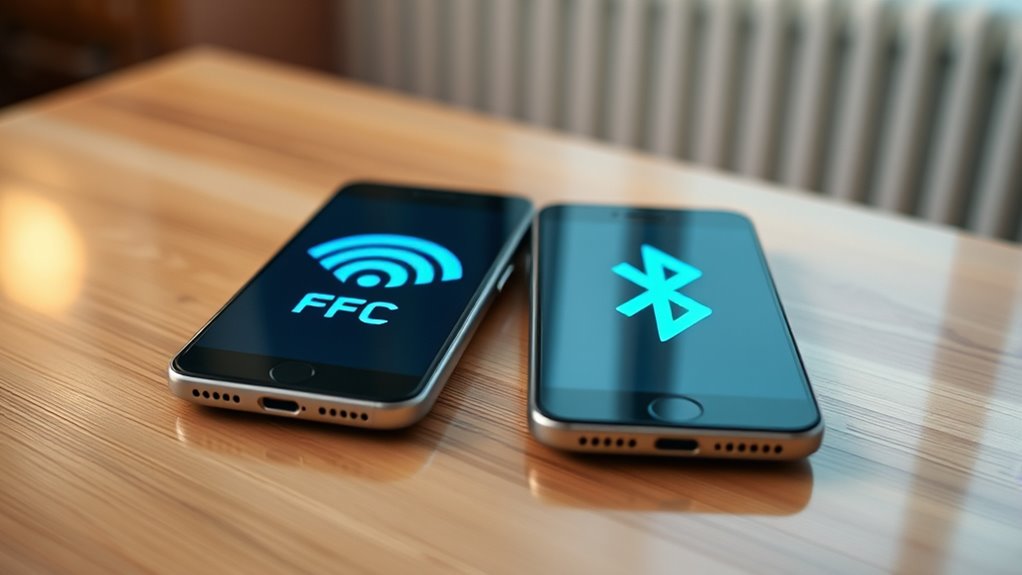

NFC and Bluetooth both enable contactless payments but differ in range, security, and energy use. NFC operates within a few centimeters, making it highly secure and ideal for quick transactions, while Bluetooth offers longer distances up to several meters, which can pose security risks if not properly encrypted. NFC is more energy-efficient due to its low-power design, whereas Bluetooth, especially with BLE, has improved in that area. To discover how these technologies compare in detail, keep exploring further.
Key Takeaways
- NFC’s short-range (a few centimeters) provides inherent security, ideal for contactless payments; Bluetooth’s longer range requires additional security measures.
- NFC offers low energy consumption and quick transactions, whereas Bluetooth (especially classic) consumes more power but supports broader device connectivity.
- Bluetooth Low Energy (BLE) reduces power use, but overall, NFC remains more energy-efficient for payment transactions.
- NFC is primarily used for secure payments due to its proximity requirement, while Bluetooth suits versatile device connections beyond payments.
- Advances in Bluetooth security protocols and energy efficiency improve its suitability for payments, but NFC’s physical contact still ensures safer transactions.
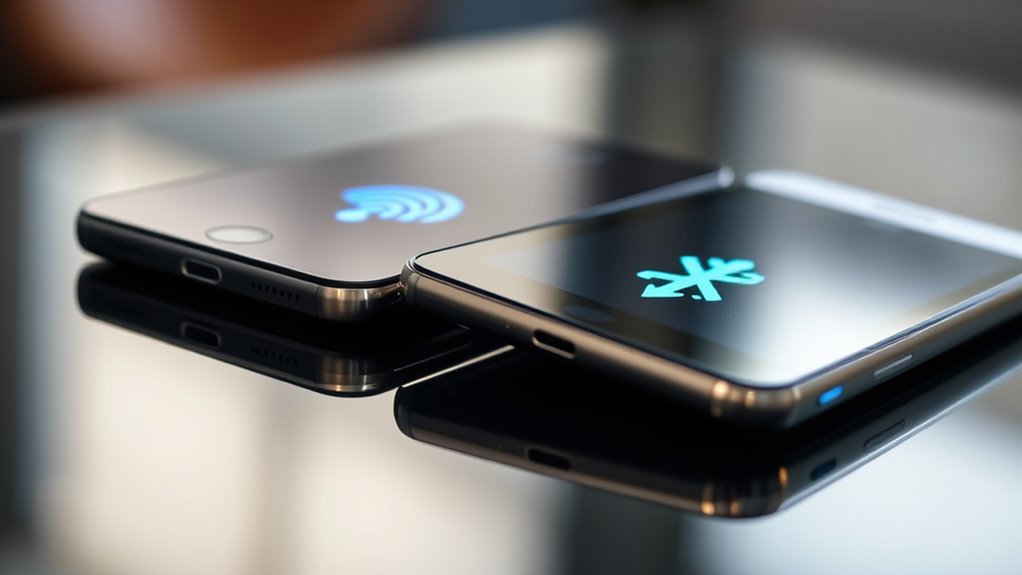
When it comes to wireless communication, NFC and Bluetooth are two popular options, each with distinct advantages. If you’re considering which technology to use for payment or data transfer, understanding their differences can help you make an informed choice. NFC, or Near Field Communication, typically operates over very short distances—usually a few centimeters—making it ideal for secure transactions like contactless payments. Bluetooth, on the other hand, offers a longer range, often up to 10 meters or more, which makes it versatile for various device connections but also introduces different security considerations.
One of the key concerns with NFC is security. Because it requires close proximity, NFC inherently reduces the risk of unauthorized access. You can’t accidentally connect to an NFC device from a distance; you have to intentionally bring your device near the terminal. This physical requirement adds a layer of security, making NFC a popular choice for payment systems where safeguarding sensitive information is critical. Bluetooth, however, can be more vulnerable due to its longer range. Without proper security protocols, Bluetooth connections can be susceptible to eavesdropping, man-in-the-middle attacks, or unauthorized pairing. Fortunately, modern Bluetooth versions incorporate advanced encryption and pairing methods, but you should still be cautious when connecting to unfamiliar devices or networks.
Energy consumption is another important factor. NFC is designed to be very power-efficient because it operates only when devices are in close contact and in active communication. This low energy usage means your devices won’t drain their batteries quickly when using NFC for quick transactions or data exchanges. Bluetooth, especially traditional versions, tends to consume more energy since it maintains a constant connection or remains in a discoverable mode for longer periods. However, newer Bluetooth standards like Bluetooth Low Energy (BLE) significantly reduce power use, making them suitable for battery-powered devices that need to stay connected for extended periods without draining their batteries. Additionally, advancements in wireless technology continue to improve energy efficiency across both NFC and Bluetooth devices.
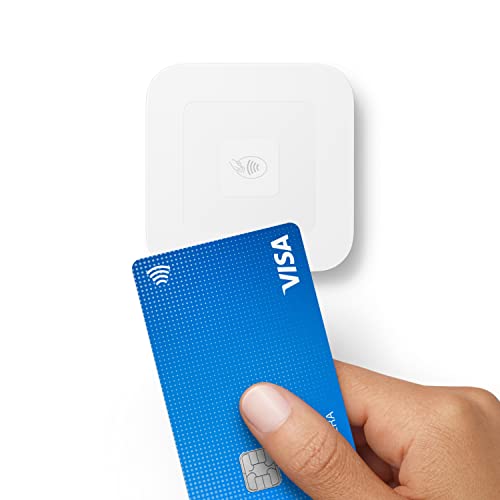
Square Reader for contactless and chip (2nd Generation)
Use the, easy-to-use, and customizable POS to get started.
As an affiliate, we earn on qualifying purchases.
As an affiliate, we earn on qualifying purchases.
Frequently Asked Questions
Can NFC and Bluetooth Be Used Together for Payments?
Yes, you can use NFC and Bluetooth together for payments, but typically not at the same time. NFC allows quick device pairing and secure transactions, enhancing your user experience. Bluetooth may be used for additional features like data transfer or device control. Combining both can improve convenience, but for payments, NFC remains the primary technology due to its speed and security. Always guarantee your device supports seamless integration for the best experience.
Which Technology Offers Better Security for Transactions?
You’ll find NFC generally offers better security for transactions because it uses robust encryption protocols and device authentication, making it harder for hackers to intercept data. Bluetooth security varies depending on the version and implementation, but it’s often more vulnerable to attacks if not properly secured. With NFC, you get quicker, more secure transactions, especially for contactless payments, giving you peace of mind when sharing sensitive information.
Are There Compatibility Issues With Older Devices?
Older devices might struggle with compatibility, making seamless technology integration feel like chasing a unicorn. If your device’s hardware is outdated, it could be like fitting a square peg into a round hole when trying to use NFC or Bluetooth for payments. Compatibility issues can cause frustration, but updating your device or using adapters can often save the day. Keep your tech up-to-date to avoid these headaches and enjoy smooth transactions.
How Does Power Consumption Compare During Transactions?
During transactions, NFC uses considerably less power than Bluetooth, making it more battery efficient and ideal for quick payments. You’ll notice lower energy usage with NFC, helping your device conserve battery life. Bluetooth consumes more power due to its longer-range capabilities and continuous connection requirements, which can drain your battery faster. For energy-conscious users, NFC offers a more efficient option, especially for frequent or quick transactions.
Can NFC or Bluetooth Be Hacked During Payment?
While no system is entirely foolproof, you’re generally protected during payments through strong wireless encryption and secure device pairing. NFC transactions are quick and use minimal data, making hacking more difficult, whereas Bluetooth requires device pairing, which adds an extra layer of security. Still, it’s wise to keep your devices updated and avoid untrusted networks to guarantee your payment info stays safe.

Getting Started with Bluetooth Low Energy: Tools and Techniques for Low-Power Networking
As an affiliate, we earn on qualifying purchases.
As an affiliate, we earn on qualifying purchases.
Conclusion
When choosing between NFC and Bluetooth for wireless payments, it all depends on your needs. NFC offers quick, secure transactions with minimal fuss, perfect for on-the-go payments. Bluetooth provides a wider range and versatility, suitable for various devices and longer distances. So, which technology fits your lifestyle better? Will you prioritize speed and security, or do you need more flexibility? Ultimately, understanding their strengths helps you make smarter payment choices every time.

50 Pcs NFC Tags Sticker with Original NTAG215 Chip NFC Stickers Adhesive Labels Transparent RFID Tags Rewritable 504 Bytes Memory Suitable for All NFC-Enabled Devices and Smartphones
Compact & Portable Design: Each package includes 50 NFC tags with a 1.0-inch round NTAG215 card, as small…
As an affiliate, we earn on qualifying purchases.
As an affiliate, we earn on qualifying purchases.

Thetis Security Key – U2F and FIDO2, USB A, Two Factor Authenticator with Bluetooth, Multi-Layered Authentication Protection HOTP U2F Compatible Windows, MacOS, Gmail, Linux – Black
Mobile Bluetooth Compatibility – Connect to various iPhone or Android devices using advanced Bluetooth Low Energy Technology. Plus,…
As an affiliate, we earn on qualifying purchases.
As an affiliate, we earn on qualifying purchases.