Soft declines happen when a payment is temporarily rejected due to issues like insufficient funds, exceeding credit limits, or fraud checks, but these can usually be resolved quickly with minor actions. Hard declines are permanent rejections caused by issues like closed accounts, incorrect information, or sanctions, where retrying won’t help. Understanding these differences can help you respond properly. Keep exploring to learn more about how you can manage these declines effectively.

Get smart everyday buys delivered free with Prime
- Fast, free delivery on millions of items
- Prime Video, Amazon Music and more included
- Member-only deals all year
Key Takeaways
- Soft declines are temporary issues that can often be resolved, while hard declines are permanent rejections of a payment attempt.
- Soft declines typically involve reasons like insufficient funds or holds, whereas hard declines often indicate invalid card details or account issues.
- Soft declines usually prompt guidance or retries, whereas hard declines usually require card or account updates.
- Soft declines are often related to security measures or temporary account conditions; hard declines suggest card or account problems.
- Recognizing the difference helps in quickly addressing issues and avoiding unnecessary transaction failures.
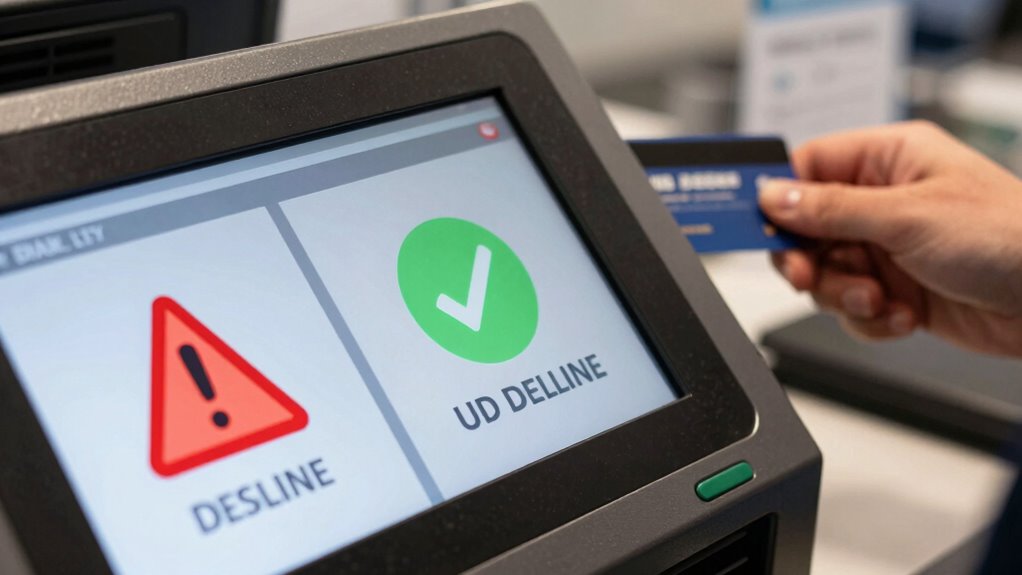
When your payment gets declined, understanding whether it’s a soft decline or a hard decline can save you time and frustration. Recognizing the difference helps you respond appropriately and keeps your transaction smooth. A soft decline occurs when the payment is initially rejected, but there’s a chance it could go through if you take some action. These declines often happen due to temporary issues, like insufficient funds, exceeding your credit limit, or a bank’s temporary hold. They’re also part of fraud prevention measures, where banks flag transactions for suspicious activity to protect you and your finances. Because of this, soft declines are often accompanied by instructions or reasons, giving you the chance to resolve the issue without significant inconvenience. For example, you might be asked to try again later, verify your information, or contact your bank. The goal here is to enhance the customer experience by giving you opportunities to complete the purchase without unnecessary hassle, as most soft declines are easily fixable. Additionally, understanding the content formats used in digital transactions can help you better navigate and troubleshoot payment issues. Knowing about transaction security measures can also assist in understanding why certain declines happen and how to address them effectively. Recognizing the importance of payment processing systems can further clarify how transactions are managed and declined. Moreover, awareness of financial technology advancements can provide insights into how these systems adapt to new security challenges. For example, newer systems incorporate real-time fraud detection, which can increase the likelihood of soft declines during suspicious activity checks.
Products Worth Considering

Canon imagePROGRAF PRO-1100 Professional 17-Inch Wireless Inkjet Photo Printer Bundle

LG UltraGear 27-Inch QHD OLED Gaming Monitor, 240Hz, 0.03ms, G-SYNC Compatible, FreeSync Premium Pro, HDMI 2.1

Apple iPad Pro 11-inch (M5), 256GB, Wi-Fi 7, Space Black
As an affiliate, we earn on qualifying purchases.
Frequently Asked Questions
Can Soft and Hard Declines Occur Simultaneously?
Yes, soft and hard declines can happen simultaneously. For example, if your credit card detects potential fraud, it might soft decline a transaction for review, while a different issue like exceeding transaction limits could cause a hard decline. Both types of declines aim to protect you from credit card fraud or unauthorized charges, but they signal different issues. Always check your account for alerts or messages to resolve these issues quickly.
How Do Declines Impact Customer Experience?
You might think declines harm customer experience, but research suggests they can actually boost trust when linked to fraud prevention and payment security. Soft declines, which suggest possible issues without blocking transactions, show you’re prioritizing security while maintaining customer engagement. Hard declines, however, can frustrate customers if they occur too often, risking lost business. Balancing these declines guarantees a secure, smooth payment process that fosters customer confidence and loyalty.
Are Soft Declines Reversible, and How?
Yes, soft declines are reversible. When you encounter a soft decline, the merchant’s credit card authorization system usually holds the transaction for review, often due to suspected fraud prevention measures or temporary issues like insufficient funds. You can often resolve this by verifying your details or trying again later. Since soft declines don’t block the transaction permanently, they typically allow for a quick resolution without impacting your credit card history.
What Are the Most Common Reasons for Hard Declines?
Imagine your payment as a fortress under siege. Hard declines often occur because of fraud prevention measures, like strong walls blocking suspicious activity, or chargeback reasons, such as invalid transactions or stolen card details. These defenses are strict, leaving no room for retries. You might see a hard decline when the system detects high-risk behavior or a dispute, making it impossible to complete the payment without addressing the core issue.
How Can Merchants Reduce Decline Rates?
To reduce decline rates, focus on improving fraud prevention measures and optimizing your payment gateway setup. Use advanced fraud detection tools to identify suspicious transactions early, minimizing false declines. Make sure your payment gateway is configured correctly for smooth processing, reducing technical errors that lead to declines. Regularly update your fraud prevention protocols and maintain open communication with your payment processor to catch issues before they cause unnecessary declines.
Conclusion
Think of soft and hard declines like a friendly tap on your shoulder versus a locked door. When your payment soft declines, it’s like a gentle nudge—you can usually fix it quickly. But a hard decline is a closed door, meaning you’ll need to take more steps. I once watched a small business owner struggle with a hard decline, feeling like they hit a brick wall. Understanding the difference helps you navigate payment issues smoothly and keep your business moving forward.