
For most buyers seeking gold investment coins, I’d start with the standard 1 oz American Gold Buffalo in random year: it pairs .9999 fine gold with a widely recognized U.S. Mint format, without making a special label the main reason to buy. The 1 oz American Gold Eagle is a standout for buyers who value its established U.S. bullion design, while the 1/10 oz Eagle offers a smaller entry size and more flexibility when selling part of a holding. The tradeoff is between gold weight and divisibility on one side, and premiums, grading, and collectible packaging on the other. Proof, MS-70, and First Day of Issue versions may appeal to collectors, but those attributes do not add gold content. Read on for the full comparison and guidance on choosing a coin that fits your budget, resale plans, and collecting preferences.

Get smart everyday buys delivered free with Prime
- Fast, free delivery on millions of items
- Prime Video, Amazon Music and more included
- Member-only deals all year
Key Takeaways
- Standard bullion formats lead for investment simplicity: The 1 oz Buffalo and 1 oz Eagle offer a clearer focus on gold weight than graded, proof, or specially labeled versions.
- Fractional Eagles trade lower outlay for more gold per ounce cost: The 1/10 oz options are easier to buy in small increments, but smaller coins commonly carry higher premiums relative to their gold content.
- Grade and label are not the same as bullion value: MS-70, Gem Uncirculated, and First Day of Issue designations may interest collectors, but buyers should separate those features from the coin’s metal value.
- Purity and recognition vary across the lineup: The .9999 fine Buffalo and Maple Leaf differ from the American Gold Eagle’s alloyed composition, while the Krugerrand and French 20 Francs bring distinct formats and market familiarity.
- Proof and historic coins add a collector dimension: The 2006 Proof Gold Buffalo and French Gold Rooster suit buyers drawn to presentation or history, but require more attention to premium and resale audience than standard bullion.






| gold investment coin | Denomination | Year | Diameter | Purity |
|---|---|---|---|---|
| 2024 1 oz American Gold Buffal | $50 | 2024 | 32.7 mm | 99.99% |
| 2026 American Gold Eagle 1/10 | $5 | 2026 | — | — |
| Canadian 1 Gram .9999 Gold Map | 50 cents | Random year, 2014 or later | 8 mm | 99.99% (.9999 fine) |
| American Gold Eagle Coin | $50 | — | 32.7 mm | 91.67% (0.9167 fine) |
| 2026 Australia Gold Kangaroo 1 | $15 | 2026 | 16.1 mm | 99.99% fine gold (24 karat) |
| 2026 | $50 | 2026 | 0.65 inches | 91.67% |
| American Gold Eagle 1/10 oz Bu | $5 | Random year, 1986–present | — | — |
| 2024 1 oz American Gold Buffal | $50 | 2024 | 32.7 mm | .9999 fine gold (99.99%) |
| 2006 U.S. Mint Proof Gold Buff | $50 | 2006 listing; random date stated | — | Listed as 100% |
| South African Gold Krugerrand | 1 Rand | Random year | 32.8 mm | — |
| 1 oz American Gold Buffalo Coi | $50 | Random, 2006–present | 32.7 mm | 99.99% fine, 24K |
| French Gold Rooster Coin | 20 Francs | Random, 1899–1914 | 21 mm | — |
| 1986–Present Random Year 1/10 | $5 | Random, 1986–present | 16.5 mm | 91.67% |
| 2025 1/10 oz American Gold Eag | $5 | 2025 | 16.5 mm | — |
| 2025 1 oz American Gold Buffal | $50 | 2025 | — | 100% (24K) |
More Details on Our Top Picks
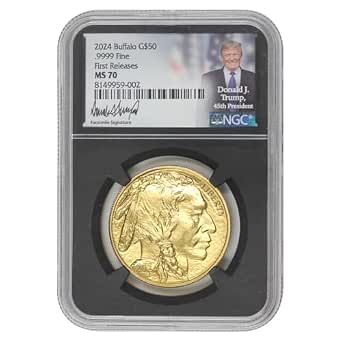
2024 1 oz American Gold Buffalo Coin MS-70 $50 NGC
I’d choose this 2024 Gold Buffalo when condition and documented presentation matter as much as owning a full ounce of gold. Its .9999 purity is higher than the American Gold Eagle and the MS-70 NGC grade gives buyers a coin certified at the top of the grading scale, rather than an ungraded bullion piece. The listing also specifies a First Release Trump Label, a detail that may appeal to collectors who value label distinctions, though it does not change the coin’s gold content.
The tradeoff is that the premium associated with grading and presentation may make this less efficient for a buyer focused mainly on gold weight. Compared with the random-year PCGS Gem Uncirculated Gold Eagle, this is a more specific, high-grade Buffalo choice, but it offers less flexibility on year and potentially less emphasis on bullion value per purchase.
Pros:- Contains 1 troy ounce of .9999 fine gold
- NGC-certified MS-70 grade provides a defined condition assessment
- First Release designation and Trump Label add specific collector appeal
- Buffalo design offers a distinct alternative to the Gold Eagle
Cons:- Grading and label premiums can reduce its appeal as a straightforward bullion holding
- Fixed 2024 issue gives less year-selection flexibility than random-year alternatives
Best for: Buyers seeking a one-ounce, high-purity American Gold Buffalo with NGC certification and a specific First Release label.
Not ideal for: Gold-weight-focused buyers who would rather avoid paying extra for a certified grade, label, and fixed year.
- Year:2024
- Gold weight:1 oz
- Purity:99.99%
- Denomination:$50
- Diameter:32.7 mm
- Grade:MS-70
- Grading service:NGC
- Label:Trump Label; First Release
Our verdict“Choose this Buffalo if you want a full ounce of .9999 gold with a top-grade NGC certification, and skip it if minimizing collector premiums is your priority.”
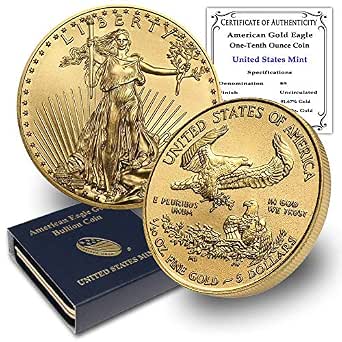
2026 American Gold Eagle 1/10 oz Bullion Coin
For a buyer who wants a small, recognizable U.S. bullion coin, this 2026 Gold Eagle offers a clear entry point at one-tenth troy ounce. Its U.S. Mint origin and familiar Liberty and bald eagle designs distinguish it from the one-gram Canadian Maple Leaf: this coin contains more gold, but its 91.67% fineness is lower than the Maple Leaf’s .9999. The Eagle’s stated weight refers to its gold content, not its total coin weight.
The smaller denomination can make it easier to buy fractional gold rather than committing to the full ounce found in the PCGS Gem Uncirculated Gold Eagle. That flexibility comes with a meaningful tradeoff: buyers hold only a tenth of an ounce, and fractional pieces can carry a higher premium relative to their gold content. I’d favor this over the 1/10 oz Kangaroo when U.S. Mint provenance and Eagle designs matter more than 24-karat purity.
Pros:- Contains 1/10 troy ounce of gold in a compact fractional format
- Issued by the U.S. Mint with recognizable Liberty and bald eagle designs
- Uncirculated condition is specified
- Certificate of authenticity is included
Cons:- Contains substantially less gold than the one-ounce coins in this roundup
- 91.67% gold fineness is lower than the .9999 purity of the Maple Leaf and Kangaroo
- Fractional coins may carry more premium per ounce than larger bullion coins
Best for: Newer U.S.-focused bullion buyers who want a recognizable, one-tenth-ounce coin instead of a full-ounce commitment.
Not ideal for: Buyers prioritizing the highest gold fineness or maximizing gold weight in a single coin.
- Year:2026
- Gold content:1/10 troy oz
- Composition:91.67% gold (.9167 fine)
- Denomination:$5
- Total item weight:2.86 g
- Mint:U.S. Mint
- Condition:Uncirculated
- Certificate:Certificate of authenticity included
Our verdict“Pick this Gold Eagle if you want a small U.S. Mint bullion coin with familiar designs, but choose a larger or finer-gold coin if content per purchase matters more.”
Canadian 1 Gram .9999 Gold Maple Leaf Coin, 50 Cents, Brilliant Uncirculated (Random Year)
This 1-gram Gold Maple Leaf is the smallest gold holding in this group, making it suited to buyers who want to acquire gold in very small increments rather than buy a tenth-ounce coin like the 2026 American Gold Eagle. Its .9999 purity matches the one-ounce Gold Buffalo’s fineness, but the Maple Leaf contains just 1 gram—about 0.0322 troy ounce—so the difference in total gold content is substantial. The divisible blister card, serial number, and certificate provide identifying and packaging details that are useful when keeping a small piece protected.
Small format is also the central compromise: there is very little gold in each unit, and its tiny 8 mm diameter may be less satisfying to buyers seeking a conventional coin to display. The 1/10 oz Australian Kangaroo carries more than three times the gold content, while still offering fractional sizing. This Maple Leaf makes more sense when fine-grained purchasing matters more than accumulating weight quickly; the year is random, so it is not a date-specific collectible choice.
Pros:- Made from 99.99% fine gold
- One-gram format allows very small gold purchases
- Divisible blister card includes a unique serial number
- Certificate of authenticity is included
Cons:- Contains only 0.0322 troy ounce of gold
- Random year prevents choosing a specific issue date
- Small 8 mm size may be less convenient to handle or display
Best for: Buyers who want to acquire or hold gold in one-gram increments with high purity and individually identified packaging.
Not ideal for: Investors aiming to build gold weight efficiently or collectors who require a particular year.
- Gold weight:1 g (0.0322 troy ounces)
- Purity:99.99% (.9999 fine)
- Diameter:8 mm
- Denomination:50 cents
- Mint:Royal Canadian Mint
- Condition:Brilliant Uncirculated
- Year:Random year, 2014 or later
- Packaging:Divisible blister card with unique serial number
Our verdict“Choose this Maple Leaf for high-purity gold in one-gram increments, not for buyers seeking substantial gold content in each coin.”
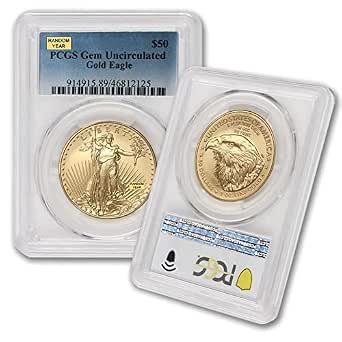
American Gold Eagle Coin, 1 oz, $50, Random Year (1986–Present), PCGS Gem Uncirculated
I’d put this PCGS Gem Uncirculated Gold Eagle ahead of fractional options for buyers who want a full troy ounce in a single coin and value a third-party condition grade. It pairs the familiar American Eagle design with PCGS certification, while its random year from 1986 onward keeps the purchase focused on the coin type rather than a chosen date. Compared with the fixed-year, MS-70 Gold Buffalo, this is less specific about issue and grade level, but it offers the Eagle’s established design and a one-ounce gold payload.
The alloy is 91.67% gold, unlike the Buffalo’s .9999 fine gold, though the stated precious-metal content remains one troy ounce. Buyers should also accept uncertainty: the coin may be Type 1 or Type 2, and the stock photo is representative rather than a promise of the exact coin. I’d choose this over the ungraded bullion choices when PCGS certification matters, but not if exact year or variety is a requirement.
Pros:- Contains 1 troy ounce of gold
- PCGS-certified Gem Uncirculated condition
- American Gold Eagle design is recognizable within the lineup
- Broad random-year range offers issues from 1986 onward
Cons:- Year and Type 1 or Type 2 variety are not selected by the buyer
- 91.67% gold fineness is lower than the Gold Buffalo and Maple Leaf
- Stock photo does not show the exact coin that will be supplied
Best for: Buyers seeking a one-ounce American Gold Eagle with PCGS certification who are comfortable with a random year and type.
Not ideal for: Collectors who need a specific date or Type 1/Type 2 variety, or buyers seeking .9999 fine gold.
- Gold content:1 troy ounce
- Purity:91.67% (0.9167 fine)
- Denomination:$50
- Diameter:32.7 mm
- Thickness:2.87 mm
- Grade:Gem Uncirculated
- Grading service:PCGS
- Year and variety:Random year, 1986–present; Type 1 or Type 2
Our verdict“Choose this coin for a PCGS-certified, full-ounce Gold Eagle if random year and variety are acceptable.”
2026 Australia Gold Kangaroo 1/10 oz Coin, $15, Brilliant Uncirculated
The 2026 Gold Kangaroo is my fractional choice for buyers who want 24-karat purity without stepping up to a full-ounce coin. It contains 0.1 troy ounce of .9999 fine gold, giving it more gold content than the 1-gram Maple Leaf while keeping the outlay in a smaller format than the full-ounce PCGS Gold Eagle. Its fixed 2026 date also makes it a more defined issue than the random-year Eagle and Maple Leaf options.
This is not the pick for someone who values U.S. Mint origin or the Eagle’s American design: the Kangaroo is an Australian coin, and its $15 denomination reflects its own issuing country. The included acrylic capsule and certificate support protected storage and identification, but the stock image may not match the exact appearance of the coin received. Compared with the 1/10 oz American Gold Eagle, the Kangaroo offers higher fineness, while the Eagle may suit buyers who prioritize U.S. Mint provenance.
Pros:- Contains 0.1 troy ounce of 99.99% fine gold
- 2026 issue provides a specific year rather than a random date
- Protective acrylic capsule is included
- Certificate of authenticity is included
Cons:- Contains only one-tenth troy ounce, less than the full-ounce options
- Australian issue may not suit buyers focused on U.S. Mint coins
- Stock photo is indicative, so the received coin may differ in appearance
Best for: Fractional-gold buyers who want a dated 2026 coin with .9999 purity and protective packaging.
Not ideal for: Buyers who prefer U.S. Mint coins, need a full ounce in one coin, or require the exact pictured appearance.
- Year:2026
- Country:Australia
- Gold content:0.1 troy ounces
- Purity:99.99% fine gold (24 karat)
- Denomination:$15
- Diameter:16.1 mm
- Thickness:1.5 mm
- Condition and packaging:Brilliant Uncirculated; protective acrylic capsule
- Included:Certificate of authenticity
Our verdict“Choose the Kangaroo if you want a dated, high-purity fractional coin with a capsule, and favor the American Gold Eagle if U.S. Mint provenance matters more.”
2026 (W) 1 oz American Gold Eagle Gem Uncirculated $50 PCGS GEMUNC
This 2026 American Gold Eagle suits buyers who want a one-ounce coin with a graded condition rather than a standard bullion presentation. Its PCGS Gem Uncirculated certification gives the coin a defined condition grade, while the First Strike designation adds a collectibility angle beyond its gold content. Compared with the South African Gold Krugerrand in this lineup, it offers a U.S. Mint design and $50 face value, but both provide one troy ounce of gold and PCGS Gem Uncirculated grading.
The tradeoff is that certification and strike labels may matter more to collectors than to buyers focused strictly on bullion. The description lists no mint mark, and a single-coin pack is not suited to building a larger position at once. I’d choose this over the random-year Eagle when a specific 2026 issue and PCGS holder matter; I’d skip the grading premium if gold weight is the only priority.
Pros:- Contains one troy ounce of gold.
- PCGS Gem Uncirculated grading provides a stated condition standard.
- First Strike designation adds a collector-focused distinction.
- American Gold Eagle design carries a $50 face value.
Cons:- The grading and First Strike labels may add little value for buyers focused on bullion content.
- No mint mark is listed, which may limit appeal to collectors seeking a particular mint identification.
- The listing is for one coin, not a bulk option.
Best for: Buyers who want a dated, PCGS-certified one-ounce American Gold Eagle for a collection that also carries substantial gold content.
Not ideal for: Bullion buyers focused only on accumulating gold weight, or purchasers seeking multiple coins in one package.
- Year:2026
- Gold weight:1 troy ounce
- Denomination:$50
- Purity:91.67%
- Grade:Gem Uncirculated (GEMUNC)
- Grading provider:PCGS
- Strike designation:First Strike
- Diameter:0.65 inches
Our verdict“Choose this Eagle if a dated PCGS-certified coin matters alongside its one-ounce gold content; choose a less label-focused bullion coin if it does not.”
American Gold Eagle 1/10 oz Bullion Coin with Certificate of Authenticity, Random Year
This 1/10-ounce American Gold Eagle is the accessible-size choice in this group: it gives buyers a recognized U.S. coin without requiring a one-ounce purchase. Its certificate of authenticity and Mint State description make it a straightforward option for someone starting a physical gold collection. Compared with the 2026 one-ounce Gold Eagle, it contains one-tenth the gold and is easier to buy in smaller increments, though it is not the choice for building a full-ounce holding efficiently.
The main compromise is uncertainty: the year and reverse design vary, so it is less suitable for date-specific collecting. The coin is also 91.67% gold rather than the .9999 purity of the Gold Buffalo options here. I’d favor this over the Buffalo coins for a lower gold-content entry point, but buyers who want a fixed year, a graded holder, or maximum purity should look elsewhere in the lineup.
Pros:- Contains 1/10 troy ounce of gold for a smaller incremental purchase.
- American Gold Eagle is a recognizable U.S. coin design.
- Certificate of authenticity is included.
- Mint State grade is specified.
Cons:- Year and reverse design are selected at random.
- Its 91.67% gold composition is less pure than the Gold Buffalo coins in this roundup.
- Contains substantially less gold per coin than the one-ounce options.
Best for: New gold buyers who want a recognizable U.S. bullion coin in a smaller gold-weight increment and do not need a specific year.
Not ideal for: Collectors seeking a particular date or reverse design, or investors prioritizing one-ounce coins and .9999 fine gold.
- Gold content:1/10 troy ounce
- Composition:91.67% gold
- Total item weight:2.86 g
- Denomination:$5
- Mint:U.S. Mint
- Year:Random year, 1986–present
- Grade:Mint State
- Included:Certificate of authenticity
Our verdict“Pick this random-year Eagle to begin with a smaller gold increment, but choose a fixed-date or one-ounce coin if those priorities matter more.”
2024 1 oz American Gold Buffalo Coin, MS-70 PCGS, First Day of Issue Bison Label
For buyers who want a one-ounce, .9999 fine gold coin with a top PCGS grade, this 2024 Gold Buffalo has a clear case. Its 24-karat composition differs from the 91.67% gold Eagle and Krugerrand options here, giving purity-focused buyers a direct reason to choose it. The PCGS MS-70 grade and First Day of Issue Bison label add a collector presentation that the random-year Gem Uncirculated Krugerrand does not offer.
Those labels are also the tradeoff: this is a dated, graded coin, so buyers paying attention only to gold content may prefer a simpler bullion piece. Its $50 denomination matches the one-ounce Eagle, but the Buffalo’s appeal rests more on its .9999 purity and label than on the Eagle’s U.S. gold alloy. I’d select it over the proof Buffalo when purity and an MS-70 certification lead; I’d choose the proof when presentation and mint packaging matter more.
Pros:- Contains one ounce of .9999 fine gold.
- PCGS MS-70 grade is specified.
- First Day of Issue Bison label gives the coin a distinct certified presentation.
- 2024 date is specified.
Cons:- Certification and label distinctions may matter less to buyers focused solely on gold content.
- No mint mark is listed.
- The supplied product details do not specify mint-issued packaging or a certificate of authenticity.
Best for: Purity-focused buyers seeking a one-ounce American gold coin with PCGS MS-70 grading and a distinctive issue label.
Not ideal for: Bullion buyers who do not value certification or labels, and collectors who specifically want a proof finish or mint-issued packaging.
- Year:2024
- Gold weight:1 oz
- Purity:.9999 fine gold (99.99%)
- Denomination:$50
- Grade:MS-70
- Grading service:PCGS
- Label:First Day of Issue, Bison
- Diameter:32.7 mm
Our verdict“Choose this Buffalo for one ounce of .9999 gold in a PCGS MS-70 holder; skip the label premium if you want bullion without collector presentation.”
2006 U.S. Mint Proof Gold Buffalo Coin, 1 Troy Ounce, Random Date
This proof Gold Buffalo is the presentation-led choice: it pairs one troy ounce of gold with a proof finish, a mint-issued box and display case, and a Certificate of Authenticity. Compared with the 2024 PCGS MS-70 Buffalo, this listing emphasizes U.S. Mint packaging and proof format rather than a third-party grade and First Day of Issue label. That distinction matters to collectors who plan to display the coin, while both options offer the Buffalo design and one-ounce size.
The listing also identifies this as a 2006 coin but describes the date as random, so buyers should not assume they can request a particular year. Its proof presentation may be less appealing to someone who wants a simple bullion coin to store, and the supplied purity detail of 100% should be verified against the specific coin’s official specifications before purchase. I’d choose it over the MS-70 Buffalo for the included display presentation, not for a graded condition claim.
Pros:- Contains one troy ounce of gold.
- Proof finish is suited to display-oriented collecting.
- Includes a U.S. Mint-issued box and display case.
- Certificate of Authenticity is included.
Cons:- The random-date wording leaves the delivered date uncertain.
- No third-party grading service or grade is specified.
- The supplied 100% purity claim should be checked against official coin specifications.
Best for: Collectors who want a one-ounce Gold Buffalo in proof format with U.S. Mint display packaging and an authenticity certificate.
Not ideal for: Buyers seeking a PCGS-graded coin, a guaranteed requested date, or a no-frills bullion piece focused on gold content.
- Year:2006 listing; random date stated
- Gold weight:1 troy ounce
- Denomination:$50
- Composition:Gold
- Purity:Listed as 100%
- Finish:Proof
- Mint mark:W
- Packaging and included item:Mint-issued box, display case, and Certificate of Authenticity
Our verdict“Choose this proof Buffalo for its mint-issued display set and certificate, not if a PCGS grade or date certainty is your priority.”
South African Gold Krugerrand Coin, 1 Rand, 1 Troy Ounce, PCGS Gem Uncirculated (Random Year)
The South African Krugerrand offers a one-ounce alternative to the U.S. coins in this roundup, with PCGS Gem Uncirculated grading and a stated 91.67% gold purity. That composition matches the American Gold Eagle’s listed purity, while the 2024 Gold Buffalo contains .9999 fine gold. Buyers choosing between them are weighing coin tradition and certified condition against purity: the Krugerrand is not the high-purity pick, but it brings a different national design and a familiar one-ounce format.
The random year is the main collecting limitation; specific dates cannot be requested, and the listing warns that the received coin may differ from its stock image. Compared with the dated 2026 Gold Eagle, this is less precise for assembling a year-specific set. I’d choose it for a graded international bullion coin without a date requirement, but skip it if a particular year, a U.S. design, or .9999 gold is central to the purchase.
Pros:- Contains one troy ounce of gold.
- PCGS Gem Uncirculated grade is specified.
- Offers a South African design distinct from the American Eagle and Buffalo.
- 91.67% gold composition matches the listed American Gold Eagle purity.
Cons:- Year is random and specific-year requests are not accepted.
- At 91.67% purity, it is less pure than the Gold Buffalo options.
- The stock image may not match the coin delivered.
Best for: Buyers seeking a PCGS-certified, one-ounce international gold coin who are comfortable receiving a random year.
Not ideal for: Date-focused collectors, buyers who want a U.S. coin design, or purity-first purchasers preferring the .9999 Gold Buffalo.
- Country and coin:South African Krugerrand
- Denomination:1 Rand
- Gold weight:1 troy ounce
- Gold purity:91.67% (.9167 fine)
- Grade:Gem Uncirculated
- Grading service:PCGS
- Year:Random year
- Diameter:32.8 mm
- Thickness:2.84 mm
Our verdict“Choose the Krugerrand for a graded one-ounce international coin if the year is flexible; select a Gold Buffalo for higher purity.”
1 oz American Gold Buffalo Coin, Gem Uncirculated, Random Year (2006–Present)
I’d shortlist this Buffalo for buyers who want a full troy ounce of 24-karat gold in a recognized American coin, without paying for a specified year. Its 99.99% purity is higher than the 91.67% gold content of the 1/10 oz American Eagle options here, while the one-ounce format gives a more substantial gold holding in a single coin. PCGS Gem Uncirculated grading adds a condition assessment, though it does not make the random year predictable. That is the main tradeoff: buyers who care about a particular date or a flawless MS70 collectible should look instead at the 2025 PCGS MS70 First Day of Issue Buffalo. I’d choose this version for gold content and graded condition, not for a date-specific collection; the larger unit also offers less flexibility when selling only part of a holding.
Pros:- Contains one troy ounce of 99.99% fine, 24-karat gold.
- PCGS Gem Uncirculated grade provides a third-party condition designation.
- American Gold Buffalo design is a recognizable U.S. gold coin.
- Full-ounce format concentrates gold content in one coin.
Cons:- Year is selected at random, and specific dates cannot be requested.
- A one-ounce coin is less divisible than the 1/10 oz American Eagle options.
- Gem Uncirculated is not the same as the MS70 grade on the 2025 First Day of Issue Buffalo.
Best for: Buyers seeking one full ounce of high-purity American gold in a PCGS-graded coin, with no need to choose the year.
Not ideal for: Date-focused collectors and buyers who want smaller, more divisible gold units or an MS70 First Day of Issue designation.
- Coin type:American Gold Buffalo
- Year:Random, 2006–present
- Denomination:$50
- Precious metal weight:1 troy ounce
- Purity:99.99% fine, 24K
- Grade:Gem Uncirculated (GEMUNC), PCGS
- Diameter:32.7 mm
- Thickness:2.95 mm
Our verdict“Choose this Buffalo if you prioritize a full ounce of .9999 fine gold over a chosen date or a top-tier collectible designation.”
French Gold Rooster Coin, 20 Francs (Random Year, 1899–1914), Brilliant Uncirculated
The French 20 Francs Rooster suits buyers who want a smaller historic gold coin rather than a modern U.S. bullion issue. Its .1867 troy ounces of gold sits between the 1/10 oz American Eagle coins and the one-ounce Buffaloes, offering a middle-size holding without committing to a full ounce. The certificate of authenticity and Brilliant Uncirculated condition are useful details, but this coin contains 90% gold rather than the 99.99% in the Gold Buffalo. That distinction matters if fine-gold purity is the main selection rule. Its random date and indicative stock photo also mean the delivered coin may not match a collector’s preferred year or appearance. Compared with the boxed 1/10 oz American Eagle, this is the more historically distinctive choice, but it has less standardized modern U.S. bullion appeal.
Pros:- Contains .1867 troy ounces of gold, more than a 1/10 oz coin but far less than a full ounce.
- Brilliant Uncirculated condition is specified.
- Certificate of authenticity is included.
- Historic French 20 Francs format offers an alternative to modern U.S. bullion designs.
Cons:- 90% gold composition is less pure than the Gold Buffalo’s 99.99% gold.
- Year is selected at random from 1899–1914.
- Stock photo is indicative, so the received coin may differ in appearance.
Best for: Buyers who want a fractional gold holding with European coinage history and are comfortable with a random year and circulated-era design.
Not ideal for: Investors seeking .9999 fine gold, a current-year U.S. coin, or control over the exact date and appearance.
- Denomination:20 Francs
- Year:Random, 1899–1914
- Condition:Brilliant Uncirculated
- Gold composition:90% gold
- Gold content:0.1867 troy ounces
- Weight:5.4 g
- Diameter:21 mm
- Certificate:Certificate of authenticity included
Our verdict“Pick the Rooster if you value a historic, mid-fractional coin more than the higher purity and modern U.S. recognition of the Buffalo and Eagle options.”
1986–Present Random Year 1/10 oz American Eagle Gold Coin ($5)
I’d favor this random-year Eagle when smaller gold units matter more than owning a full ounce at once. At 0.10 troy ounces, it is easier to divide a holding across multiple coins than the one-ounce Buffalo, and the U.S. Mint presentation box and certificate give it a more gift-ready package than the Rooster. Its 91.67% gold composition is lower than the Buffalo’s 99.99%, although the stated gold content remains 0.10 troy ounces. The coin’s year is assigned randomly, and the listing allows either Type 1 or Type 2, so it is not the right pick for someone building a precise date or design set. Compared with the fixed-year 2025 1/10 oz Eagle, this version trades date certainty for a broader possible year range.
Pros:- Contains 0.10 troy ounces of gold in a compact fractional format.
- U.S. Mint presentation box and certificate of authenticity are included.
- Random year range spans 1986 to the present.
- Brilliant Uncirculated condition is specified.
Cons:- Random year and Type 1 or Type 2 selection limit control over the exact coin.
- 91.67% purity is below the 99.99% Gold Buffalo.
- The 16.5 mm coin may feel small to buyers who want a more substantial display piece.
Best for: Newer gold buyers and gift-givers who prefer a small U.S. coin, presentation packaging, and flexibility to accumulate in fractional units.
Not ideal for: Collectors who need the 2025 date or a specific Eagle type, and buyers prioritizing the highest gold purity per coin.
- Purity:91.67%
- Gold content:0.10 troy ounces
- Weight:2.86 g
- Diameter:16.5 mm
- Thickness:1.19 mm
- Denomination:$5
- Year:Random, 1986–present
- Grade:Brilliant Uncirculated, Type 1 or Type 2
- Included:U.S. Mint presentation box and certificate of authenticity
Our verdict“Choose this Eagle for a packaged, fractional U.S. gold coin when a particular year and type are not priorities.”
2025 1/10 oz American Gold Eagle Coin, $5, Brilliant Uncirculated
This 2025 Eagle makes the most sense for buyers who want the fractional format of the random-year American Eagle but need a stated date. Its 0.10 troy ounces of gold and 16.5 mm diameter match that coin’s compact scale, while the fixed 2025 issue avoids uncertainty over the year and type. Like the other Eagle, it is 22-karat gold at 91.67% purity, so buyers focused on the Buffalo’s 24-karat composition should look elsewhere. The listing includes a certificate of authenticity, but no presentation box is specified here, unlike the random-year Eagle. The stock image is indicative, so the received coin may vary in appearance. I’d pick this over the random-year version for a date-specific purchase, but not if packaging or a higher-purity coin is the priority.
Pros:- Fixed 2025 date removes the random-year uncertainty of the other 1/10 oz Eagle.
- Contains 0.10 troy ounces of gold in a compact format.
- Brilliant Uncirculated grade is specified.
- Certificate of authenticity is included.
Cons:- At 0.10 troy ounces, it contains much less gold than either one-ounce Buffalo.
- 91.67% gold purity is lower than the Gold Buffalo’s 99.99%.
- Stock photo is indicative, and a presentation box is not listed as included.
Best for: Buyers who want a 2025-dated fractional American Gold Eagle for a year-specific collection or gift.
Not ideal for: Buyers who want a presentation box, a larger gold holding, or the 99.99% purity of the one-ounce Buffalo.
- Year:2025
- Denomination:$5
- Gold purity:91.67% (22 karat)
- Gold content:0.10 troy ounces (3.11 g)
- Total item weight:3.39 g
- Diameter:16.5 mm
- Thickness:1.19 mm
- Grade:Brilliant Uncirculated
- Included:Certificate of authenticity; one coin
Our verdict“Select this coin when a 2025 date matters more than presentation packaging or the greater gold content of a full-ounce coin.”
2025 1 oz American Gold Buffalo MS70 First Day of Issue $50 (PCGS)
This is the most collector-focused Buffalo in the group: it pairs one ounce of 24-karat gold with a PCGS MS70 grade and First Day of Issue designation. The fixed 2025 date and stated grade make it a more defined collectible than the random-year Gem Uncirculated Buffalo, which is better suited to buyers centered on gold content. Compared with the 2024 MS-70 Buffalo elsewhere in the roundup, this coin’s distinguishing detail is its 2025 issue; both appeal to buyers who value certification and a top numerical grade. The tradeoff is that the added collectible attributes can command a premium, while the product data does not specify a presentation case or certificate beyond the PCGS grading. I’d choose it for date-and-grade specificity, not simply as the most straightforward way to hold gold.
Pros:- Contains one troy ounce of 100% pure, 24-karat gold.
- PCGS MS70 grade provides a top numerical condition designation.
- First Day of Issue designation adds a specific collectible attribute.
- Fixed 2025 year avoids the random-date uncertainty of the Gem Uncirculated Buffalo.
Cons:- Premium grading and collectible designation may add cost beyond the gold content.
- One-ounce format is less divisible than the fractional Eagle coins.
- The supplied product data does not list presentation packaging or a separate certificate.
Best for: Numismatists who want a fixed-year, PCGS-certified one-ounce Buffalo with a stated MS70 grade and First Day of Issue designation.
Not ideal for: Gold buyers focused chiefly on bullion content who would rather avoid paying for a premium grade or collectible label.
- Year:2025
- Gold content:1 troy ounce
- Purity:100% (24K)
- Denomination:$50
- Grade:MS70
- Grading company:PCGS
- Designation:First Day of Issue
- Mint mark:W
Our verdict“Choose this Buffalo if a certified MS70 2025 collectible matters to you; choose the random-year Buffalo if your priority is gold content without the added designation.”

How We Picked
I ranked these gold investment coins by how clearly each option serves a bullion buyer: recognizable format, stated gold weight and purity, practical unit size, and how much the product’s appeal depends on grading, proof finish, or special packaging. I also considered likely buyer use: building a core holding, buying in smaller increments, or combining gold exposure with collecting. A coin’s label or grade does not change its gold content, so those features count as collector benefits rather than automatic investment advantages.
That logic puts standard, full-ounce bullion formats ahead of products where a premium may be tied to a specific grade, label, or presentation. Fractional coins rank well for accessibility and divisibility, though buyers should compare their total cost with the gold weight received. The Maple Leaf, Krugerrand, and French Rooster bring useful alternatives in purity, design, or historical character, but may suit narrower preferences. This is a comparison of product formats, not a guarantee of future resale value; buyers should confirm current specifications, seller terms, and authentication details before purchasing.
Factors to Consider When Choosing Gold Investment Coins
Choosing among gold investment coins is less about finding a single universally best design and more about matching gold weight, resale flexibility, and collector appeal to your plan. I’d settle the practical questions first, then decide whether a special grade or historic issue is worth paying extra attention to.
Choose Gold Weight Before Design
Start by deciding how much gold you want each purchase to represent, rather than choosing a coin by its face value or appearance. A one-ounce coin makes the gold content straightforward to compare, while a tenth-ounce coin lets you buy and potentially sell in smaller units. That flexibility has a tradeoff: fractional pieces can carry a higher premium per ounce, so compare total spend against stated gold weight. Do not assume a coin’s denomination equals its bullion value; the denomination is a legal face value, not a measure of its metal worth. For a long-term holding, a simple record of weight, purity, purchase date, and seller can make later comparisons easier. If you may need to sell only part of your gold, smaller units can be more practical than dividing a larger holding.
Compare Purity, Alloy, and Coin Type
Purity is only one part of the comparison: the American Gold Eagle contains gold alloyed with other metals, while the Buffalo and Maple Leaf are presented as .9999 fine gold. Alloyed gold can make a coin more durable, but buyers should compare fine-gold content rather than relying on gross weight alone. Reputable product listings should state the coin’s weight and purity clearly; check those specifications against an authoritative mint or issuer source if anything is ambiguous. Coin designs also differ in recognition across markets, which can affect how familiar a prospective buyer or dealer is with the piece. A familiar bullion coin may be simpler to explain at resale than a less common historic issue. Choose based on the likely market where you expect to sell, not only on the purity figure.
Treat Grading and Special Labels as Collector Features
Third-party grades such as MS-70 or Gem Uncirculated describe a coin’s assessed condition, while labels like First Day of Issue identify a particular submission or release designation. Neither adds gold weight, and neither guarantees that a future buyer will pay a premium for it. Before paying more for a certified coin, compare its total cost with a standard bullion version and ask whether you personally value the certification or presentation. A sealed holder can help preserve and identify a coin, but it can also make inspection and handling different from buying a loose bullion piece. Avoid treating the highest grade as a shortcut to investment performance. If your priority is metal exposure, focus on fine-gold content, recognition, and the premium over the gold value.
Understand Premiums and Resale Costs
The purchase amount includes more than the underlying gold: fabrication, distribution, seller terms, and collector demand can all affect the premium. Smaller coins and special releases may have a larger premium relative to their gold weight than standard one-ounce bullion, so compare like with like. Ask how the seller calculates buyback offers and whether condition, packaging, or certification affects the amount they will pay. A coin that is easy to purchase is not automatically easy to resell on favorable terms. Keep invoices and any grading documentation, and store them separately from the coins. The useful comparison is not simply which coin has the lowest listed premium, but what you receive and what exit options are available.
Decide Whether Collecting Is Part of the Goal
Proof finishes, historic dates, graded condition, and distinctive labels can make a coin more appealing to a collector, but they add a second objective beyond holding gold. The 2006 Proof Buffalo and French Gold Rooster illustrate how presentation or history can matter alongside metal content. Collector demand can be narrower and less predictable than demand for familiar bullion formats, so avoid assuming that an attractive feature will retain a premium. If you value the design or historical character, treat that as a personal collecting benefit and set a budget for it separately. If you do not care about those traits, a standard bullion coin may keep the decision more focused on gold weight and recognition. Decide which goal comes first before paying for both.
Check Seller, Authenticity, and Storage
Coin choice cannot compensate for an unclear seller policy or uncertain authenticity. Buy from a seller that identifies the exact coin, weight, purity, year or random-year range, and any third-party certification; read the return and buyback terms before ordering. Random-year listings can include different dates, so confirm that the stated specifications remain consistent across eligible years. For certified products, check the grading service and holder details rather than relying on a label in the title alone. Plan storage that protects coins from loss, damage, and unauthorized access, and keep purchase records in a separate secure location. These steps matter for bullion and collectible coins alike, especially if you may need to document ownership or arrange a later sale.
Frequently Asked Questions
Should I choose a one-ounce coin or several fractional coins?
A one-ounce coin usually makes it easier to compare gold weight and may avoid some of the per-ounce premium associated with smaller pieces. Several fractional coins give you more flexibility if you want to sell only a portion of your holding or make smaller purchases over time. Compare the combined premium on the fractional coins with the cost of one larger coin, using fine-gold weight rather than face value. Also check which sizes are familiar to dealers in the market where you expect to sell. The better fit depends on whether cost efficiency or divisibility matters more to you.
Does an MS-70 or First Day of Issue coin make a better investment?
Not by itself: those designations describe grading or a submission-related label, not additional gold content. A certified coin may appeal to collectors, but its resale premium depends on whether a future buyer values that specific grade, label, and issue. Compare the certified version with a standard bullion coin and decide whether the added cost reflects a feature you actually want. If your goal is primarily gold exposure, the simpler bullion format may be easier to evaluate. If collecting is part of your goal, consider the grade and label a separate source of value that may be uncertain.
How should I compare an American Gold Eagle with a Buffalo or Maple Leaf?
Compare fine-gold content, purity, recognition, and your preference for the coin’s composition rather than judging by gross weight alone. The Eagle is alloyed with other metals, while the Buffalo and Maple Leaf are listed as .9999 fine gold. The Eagle’s U.S. bullion format may suit buyers who prefer that established design, while the Buffalo or Maple Leaf may appeal to those prioritizing higher stated purity. Familiarity among likely resale buyers can matter as much as the number on a purity specification. Verify product details with an authoritative issuer source, especially when listings describe random-year coins.
Are random-year coins a sensible choice if I want to resell later?
A random-year listing can be a practical way to buy a coin type without choosing a particular date, provided the product’s weight, purity, and condition description are clear. It is not a promise that every year will attract the same collector interest, and a specific date may matter to some buyers. If your goal is bullion, focus on the stated metal content and recognition rather than expecting a date premium. If you are collecting a series, confirm the year before purchase or select a listing that names the date. Keep the seller’s documentation, since it can help identify what you bought.
When does a proof or historic coin make sense instead of standard bullion?
A proof or historic coin can make sense when its finish, design, or history is part of what you want to own, not merely because it contains gold. Those traits may introduce a collector premium and a narrower resale audience compared with a widely recognized bullion issue. Before buying, separate the amount you are paying for the gold from the amount tied to condition or collectibility. Check how the coin is described, whether its authenticity is documented, and how a prospective buyer would evaluate it. If you mainly want straightforward gold exposure, standard bullion is usually the easier comparison point.
Conclusion
For a core holding, my best overall choice is the standard 1 oz American Gold Buffalo: its stated .9999 fine gold and familiar U.S. format keep the decision centered on bullion. For best value in practical flexibility, compare the random-year 1 oz Buffalo or Eagle against the special-label versions and choose the standard coin whose premium and seller terms suit you. The best for beginners is the 1/10 oz American Gold Eagle if smaller purchases matter more than maximizing gold weight per purchase. For a best premium collectible, the MS-70 First Day of Issue Buffalo is aimed at buyers who actively value certification and presentation, not just gold content. For specific needs, consider the Maple Leaf for .9999 fine gold in a 1-gram format, the Krugerrand for a distinct one-ounce bullion alternative, or the French Gold Rooster if historical character is part of the appeal. I’d make the final choice by comparing fine-gold weight, total premium, recognition, and resale terms before paying extra for a grade or label.
Fall Picks

Samsung Essential S3 27-Inch Curved FHD Monitor
As an affiliate, we earn on qualifying purchases.