
For budgeting laptops for personal finance, I would start with the Lenovo IdeaPad Slim 3i: its 8GB of RAM and 15.6-inch FHD screen offer a practical balance for spreadsheets, banking sites, and everyday multitasking. The Lenovo V15 G6 is another strong fit if you want 256GB of SSD storage, while the DRKAKO 15.6-inch stands out for its 12GB of RAM. The main tradeoff is between more memory and storage for handling several tasks, and lower-spec models that may suit simpler, single-app routines. I’ll compare all eight options by the features that matter for managing money, along with their limitations. Read on for the full breakdown and help choosing the right fit.

Get smart everyday buys delivered free with Prime
- Fast, free delivery on millions of items
- Prime Video, Amazon Music and more included
- Member-only deals all year
Key Takeaways
- 8GB of RAM is the clearest dividing line: the IdeaPad Slim 3i, Lenovo V15 G6, and Celeron-based FHD model offer more room for a spreadsheet, browser tabs, and email than the four listed 4GB HP configurations.
- The Lenovo V15 G6 pairs 8GB of DDR5 RAM with a 256GB SSD, giving it a stronger listed memory-and-storage combination than the IdeaPad Slim 3i, which has 128GB of storage.
- The DRKAKO model has the largest listed memory capacity at 12GB, but buyers should weigh that advantage against their preference for a more familiar brand and the details of the specific configuration.
- The four HP N150 or N250 laptops share a tight 4GB RAM and 128GB UFS configuration. Their 14- and 15.6-inch sizes, operating system editions, and included accessories shape their appeal more than multitasking capacity.
- Screen size changes the day-to-day experience: 15.6-inch models give spreadsheets more room, while the two 14-inch HP options are easier to carry but offer less workspace.
| HP 15.6-Inch Laptop with Intel N150, 4GB RAM, and 128GB UFS Storage |  | Best for Microsoft 365 Bundling | Processor: Intel N150, 4 cores, up to 3.6GHz | Memory: 4GB LPDDR5 SDRAM | Storage: 128GB UFS | VIEW LATEST PRICE | See Our Full Breakdown |
| HP 15.6-Inch Laptop with Intel N250, 4GB Memory, and 128GB UFS Storage |  | Best for Simple, Portable Budgeting | Processor: Intel N250, 4 cores, up to 3.8GHz | Memory: 4GB LPDDR5 | Storage: 128GB UFS | VIEW LATEST PRICE | See Our Full Breakdown |
| 15.6-Inch FHD Laptop with Intel Celeron N5100, 8GB RAM, 256GB SSD, Backlit Keyboard and Fingerprint Reader |  | Best for Spreadsheet Readability | Processor: Intel Celeron N5100 quad-core, up to 2.8GHz | Memory: 8GB DDR4 | Storage: 256GB SSD | VIEW LATEST PRICE | See Our Full Breakdown |
| Lenovo V15 G6 15.6-Inch FHD Laptop, Intel N100, 8GB DDR5, 256GB SSD |  | Best for Practical Home-Office Connections | Processor: Intel N100, 4 cores / 4 threads, up to 3.4GHz | Memory: 8GB DDR5-4800 SODIMM | Storage: 256GB M.2 PCIe 4.0×4 NVMe SSD | VIEW LATEST PRICE | See Our Full Breakdown |
| DRKAKO 15.6-Inch FHD IPS Laptop with 12GB RAM and 256GB SSD |  | Best for Memory and Storage Headroom | Processor: Intel J4105 quad-core | Memory: 12GB DDR4 | Storage: 256GB SSD; expansion up to 2TB SSD or 1TB microSD | VIEW LATEST PRICE | See Our Full Breakdown |
| HP 14-Inch Laptop with Intel N150, 4GB RAM, 128GB UFS Storage, Windows 11 Pro, and Accessories |  | Best Accessory Bundle | Processor: Intel N150 quad-core, up to 3.6 GHz | Memory: 4GB LPDDR5 | Storage: 128GB UFS plus 500GB external drive | VIEW LATEST PRICE | See Our Full Breakdown |
| HP 14-inch Laptop, Intel N150, 4GB RAM, 128GB UFS, Windows 11 Home |  | Best for Basic Budgeting on the Go | Processor: Intel N150 quad-core, up to 3.6 GHz | Memory: 4GB LPDDR5-4800 | Storage: 128GB UFS | VIEW LATEST PRICE | See Our Full Breakdown |
| Lenovo IdeaPad Slim 3i 15.6-Inch FHD Laptop, Intel N150, 8GB RAM, 128GB Storage |  | Best for Spreadsheet Visibility | Processor: Intel N150, 4 cores, up to 3.6 GHz | Memory: 8GB LPDDR5-4800 | Storage: 128GB UFS 2.2 | VIEW LATEST PRICE | See Our Full Breakdown |
| budgeting laptops for personal finance | Processor | Memory | Storage | Display |
|---|---|---|---|---|
| HP 15.6-Inch Laptop with Intel | Intel N150, 4 cores, up to 3.6GHz | 4GB LPDDR5 SDRAM | 128GB UFS | 15.6-inch HD anti-glare, 1366 x 768, 250 nits |
| HP 15.6-Inch Laptop with Intel | Intel N250, 4 cores, up to 3.8GHz | 4GB LPDDR5 | 128GB UFS | 15.6-inch HD anti-glare, 1366 x 768, 250 nits |
| 15.6-Inch FHD Laptop with Inte | Intel Celeron N5100 quad-core, up to 2.8GHz | 8GB DDR4 | 256GB SSD | 15.6-inch, 1920 x 1080, 60Hz |
| Lenovo V15 G6 15.6-Inch FHD La | Intel N100, 4 cores / 4 threads, up to 3.4GHz | 8GB DDR5-4800 SODIMM | 256GB M.2 PCIe 4.0×4 NVMe SSD | 15.6-inch FHD TN, 1920 x 1080, anti-glare, 250 nits |
| DRKAKO 15.6-Inch FHD IPS Lapto | Intel J4105 quad-core | 12GB DDR4 | 256GB SSD; expansion up to 2TB SSD or 1TB microSD | 15.6-inch IPS, 1920 x 1080 |
| HP 14-Inch Laptop with Intel N | Intel N150 quad-core, up to 3.6 GHz | 4GB LPDDR5 | 128GB UFS plus 500GB external drive | 14-inch HD LED, 1366 x 768, anti-glare, 250 nits |
| HP 14-inch Laptop | Intel N150 quad-core, up to 3.6 GHz | 4GB LPDDR5-4800 | 128GB UFS | 14-inch HD, 1366 x 768, anti-glare, 250 nits |
| Lenovo IdeaPad Slim 3i 15.6-In | Intel N150, 4 cores, up to 3.6 GHz | 8GB LPDDR5-4800 | 128GB UFS 2.2 | 15.6-inch FHD, 1920 x 1080, TN, anti-glare, 250 nits |
More Details on Our Top Picks
HP 15.6-Inch Laptop with Intel N150, 4GB RAM, and 128GB UFS Storage
For someone who wants a familiar Windows laptop for checking accounts, updating a household spreadsheet, and joining occasional calls, this HP pairs a full-size numeric keypad with a one-year Microsoft 365 Personal subscription and 1TB of cloud storage. That bundle gives budgeting files room for backups without relying only on the laptop’s 128GB UFS storage. Compared with the HP 15.6-Inch Laptop with Intel N250, this model lists up to 8 hours 15 minutes of mixed-use battery life and a slightly more capable N150 processor, though the N250 version has a longer stated video-playback estimate. Both have just 4GB of RAM, so keeping a budget workbook, many browser tabs, and video calls open together may feel restrictive. The 1366 x 768 display also offers less workspace than the Full HD options in this roundup.
Pros:- Numeric keypad makes entering transactions and figures more convenient.
- One-year Microsoft 365 Personal subscription includes 1TB of cloud storage.
- Camera privacy shutter and microphone mute key add useful call privacy.
- Wi-Fi 6 and a 3.52 lb weight suit everyday use around the home.
Cons:- 4GB RAM can constrain multitasking with spreadsheets, browser tabs, and calls.
- 128GB UFS storage is limited for locally stored documents and other files.
- 1366 x 768 resolution provides less spreadsheet workspace than Full HD models.
Best for: Household budgeters who mainly use spreadsheets, browser-based banking, and calls, and want Microsoft 365 with cloud storage included.
Not ideal for: People who keep many browser tabs open, work with large spreadsheets, or want a sharp Full HD display; the 4GB RAM and HD screen limit multitasking and workspace.
- Processor:Intel N150, 4 cores, up to 3.6GHz
- Memory:4GB LPDDR5 SDRAM
- Storage:128GB UFS
- Display:15.6-inch HD anti-glare, 1366 x 768, 250 nits
- Operating system:Windows 11 Home
- Wireless:Wi-Fi 6 and Bluetooth 5.4
- Battery life:Up to 8 hours 15 minutes mixed use
- Weight:3.52 lb
- Included software:One-year Microsoft 365 Personal subscription with 1TB cloud storage
Our verdict“Choose this HP if Microsoft 365 and cloud storage matter more than multitasking headroom or a Full HD screen.”
HP 15.6-Inch Laptop with Intel N250, 4GB Memory, and 128GB UFS Storage
This HP is aimed at straightforward personal finance: logging in to banking sites, entering routine expenses, and using a numeric keypad in a familiar laptop layout. Its 3.52 lb frame, Wi-Fi 6, webcam privacy shutter, and microphone mute key suit a home or school setup that may move between rooms. Against the HP 15.6-Inch Laptop with Intel N150, it uses the newer-listed N250 processor and specifies Windows 11 Home in S mode; its stated video-playback time is up to 10 hours 45 minutes, while wireless streaming is listed at up to 7 hours 30 minutes. The main constraint is shared by both HP models: 4GB RAM and 128GB storage leave little room for heavier multitasking or a large local document library. Its HD resolution is also less useful for viewing wide spreadsheets than the Full HD Lenovo V15 G6.
Pros:- Full-size keyboard with numeric keypad suits entering financial figures.
- Wi-Fi 6, privacy shutter, and microphone mute key support everyday online use.
- Light 3.52 lb design and stated video-playback runtime suit occasional portable use.
- Includes a one-year Microsoft 365 Personal subscription.
Cons:- 4GB RAM can make multitasking with several finance and banking tabs restrictive.
- 128GB UFS storage limits space for local records and downloaded files.
- HD 1366 x 768 display shows less spreadsheet content than Full HD alternatives.
Best for: Students or first-time budgeters who need a light 15.6-inch laptop for online banking, basic spreadsheets, and video calls.
Not ideal for: Spreadsheet-heavy users or anyone who wants ample local file space and a high-resolution display; its memory, storage, and HD panel are modest.
- Processor:Intel N250, 4 cores, up to 3.8GHz
- Memory:4GB LPDDR5
- Storage:128GB UFS
- Display:15.6-inch HD anti-glare, 1366 x 768, 250 nits
- Operating system:Windows 11 Home in S mode
- Wireless:Wi-Fi 6 and Bluetooth 5.4
- Ports:USB-C data, 2 x USB-A, HDMI 1.4b, headphone/microphone combo
- Weight:3.52 lb
- Battery life:Up to 10 hours 45 minutes video playback; up to 7 hours 30 minutes wireless streaming
Our verdict“Pick this HP for basic budgeting and a portable numeric-keypad layout, but choose a Full HD model with 8GB RAM for broader spreadsheet use.”
15.6-Inch FHD Laptop with Intel Celeron N5100, 8GB RAM, 256GB SSD, Backlit Keyboard and Fingerprint Reader
For budgeters who spend longer reviewing monthly transactions, this model’s 1920 x 1080 display gives spreadsheets and side-by-side windows more room than the HD screens on either HP 15.6-inch laptop. Its 8GB RAM and 256GB SSD also provide more breathing space for everyday multitasking and saved financial records than those HP configurations. A backlit keyboard helps when entering figures in dim rooms, while the fingerprint reader offers a convenient sign-in option. Compared with the Lenovo V15 G6, this laptop adds a backlit keyboard and fingerprint recognition, but its listed wireless connection is Wi-Fi 5 rather than Wi-Fi 6, and no specific battery runtime is provided. The Celeron N5100 and integrated graphics fit ordinary finance tasks, not demanding workloads; the unspecified battery life makes it harder to judge for regular use away from an outlet.
Pros:- Full HD 15.6-inch display provides more room for rows, columns, and side-by-side documents.
- 8GB RAM and 256GB SSD offer more multitasking and file capacity than the 4GB/128GB HP models.
- Backlit keyboard and numeric keypad help with data entry in varied lighting.
- Fingerprint reader adds a convenient sign-in option.
Cons:- No specific battery runtime is provided, making unplugged use difficult to plan.
- Wi-Fi 5 is an older wireless standard than the Wi-Fi 6 on the HP and Lenovo options.
- Celeron N5100 integrated graphics are intended for everyday tasks rather than demanding workloads.
Best for: Home budgeters who regularly work with wide spreadsheets, want more local storage, and value a backlit keyboard for evening use.
Not ideal for: People who need documented battery runtime, faster wireless networking, or a laptop for demanding creative and graphics workloads.
- Processor:Intel Celeron N5100 quad-core, up to 2.8GHz
- Memory:8GB DDR4
- Storage:256GB SSD
- Display:15.6-inch, 1920 x 1080, 60Hz
- Operating system:Windows 11 Pro
- Keyboard:Backlit with numeric keypad
- Biometric security:Fingerprint recognition
- Wireless:Wi-Fi 5 and Bluetooth 5
- Warranty:3 years
Our verdict“Choose this model for a sharper spreadsheet workspace and more memory than the HP options, provided its unspecified battery life is acceptable.”
Lenovo V15 G6 15.6-Inch FHD Laptop, Intel N100, 8GB DDR5, 256GB SSD
The Lenovo V15 G6 is the most connection-ready choice here for a home finance desk: it has Gigabit Ethernet, HDMI, and two USB-C ports that support power delivery and DisplayPort. Its 8GB DDR5 memory, 256GB NVMe SSD, and Full HD screen also make it a more balanced spreadsheet machine than the 4GB, HD-screen HP models. Compared with the Celeron-based 15.6-inch FHD laptop, the Lenovo trades a backlit keyboard and fingerprint reader for Wi-Fi 6, Ethernet, and USB-C display support. There are compromises: the screen uses a TN panel with 250-nit brightness and 45% NTSC color coverage, and the keyboard is not backlit. For tracking accounts and bills, those limits matter less than they would for color-sensitive work, but viewing angles are less flexible than on an IPS screen.
Pros:- Full HD anti-glare display gives spreadsheets more workspace than the HD HP screens.
- 8GB DDR5 memory and 256GB NVMe SSD suit routine finance files and multitasking.
- Gigabit Ethernet, Wi-Fi 6, and USB-C with DisplayPort and power delivery offer flexible connections.
- Camera privacy shutter and Firmware TPM 2.0 add practical privacy and security features.
Cons:- TN display has limited viewing angles, 250-nit brightness, and 45% NTSC color coverage.
- Keyboard is not backlit, which can hinder evening data entry.
- Intel N100 is geared toward everyday tasks rather than demanding workloads.
Best for: Home-office users who connect to a wired network or external monitor and want a Full HD screen with 8GB RAM for spreadsheets.
Not ideal for: People who work in dim rooms, need wide viewing angles, or want a backlit keyboard; the TN panel and unlit keyboard are notable compromises.
- Processor:Intel N100, 4 cores / 4 threads, up to 3.4GHz
- Memory:8GB DDR5-4800 SODIMM
- Storage:256GB M.2 PCIe 4.0×4 NVMe SSD
- Display:15.6-inch FHD TN, 1920 x 1080, anti-glare, 250 nits
- Operating system:Windows 11 Home
- Wireless:Wi-Fi 6 and Bluetooth 5.2
- Wired networking:Gigabit Ethernet
- Ports:2 x USB-A, 2 x USB-C with USB PD and DisplayPort, HDMI 1.4b, RJ-45
- Weight:Starting at 3.33 lb
Our verdict“Choose the Lenovo for a practical budgeting workstation with strong wired and monitor connections, unless a better viewing-angle screen or backlit keyboard matters more.”
DRKAKO 15.6-Inch FHD IPS Laptop with 12GB RAM and 256GB SSD
Among these five, the DRKAKO offers the most listed memory, with 12GB RAM, plus a 256GB SSD and stated options to expand storage. That combination can suit a budgeter who keeps records locally and runs several everyday apps at once; it gives more memory headroom than the Lenovo V15 G6’s 8GB and far more than the HP models’ 4GB. Its Full HD IPS display also provides a clearer, more flexible viewing setup than the Lenovo’s TN panel. The tradeoff is the Intel J4105 processor, an older quad-core chip that makes this a basic-use choice rather than a strong pick for heavier work. Battery life is rated for up to six hours, shorter than the HP models’ stated video-playback figures, and its Wi-Fi 5 and Bluetooth 4.2 are older standards than those on the newer HP and Lenovo options.
Pros:- 12GB RAM exceeds the listed memory in the other laptops in this batch.
- Full HD IPS display offers wider viewing angles than the Lenovo V15 G6 TN screen.
- 256GB SSD with listed expansion options supports a larger local file collection.
- 180-degree hinge and a range of ports offer flexibility for sharing the screen and connecting accessories.
Cons:- Intel J4105 is a basic-use processor and less suited to demanding workloads.
- Battery life is rated for up to six hours.
- Wi-Fi 5 and Bluetooth 4.2 are older standards than those listed for the HP and Lenovo models.
Best for: Budgeters who want extra memory, an IPS Full HD screen, and storage expansion for locally kept statements and household records.
Not ideal for: People who need longer unplugged sessions, newer wireless standards, or a laptop for demanding applications; its battery rating and J4105 processor are limiting factors.
- Processor:Intel J4105 quad-core
- Memory:12GB DDR4
- Storage:256GB SSD; expansion up to 2TB SSD or 1TB microSD
- Display:15.6-inch IPS, 1920 x 1080
- Operating system:Windows 11 Home
- Battery life:Up to 6 hours
- Wireless:Wi-Fi 5 and Bluetooth 4.2
- Ports:USB 3.2, USB-C, Mini HDMI, headphone jack, microSD slot
- Weight:3.7 lb
Our verdict“Pick the DRKAKO if memory, an IPS Full HD display, and expandable storage matter more than battery runtime and newer wireless connectivity.”
HP 14-Inch Laptop with Intel N150, 4GB RAM, 128GB UFS Storage, Windows 11 Pro, and Accessories
For personal finance tasks, this HP pairs a compact 14-inch anti-glare screen with Windows 11 Pro and a bundle that includes a 500GB external drive, USB-C hub, and wireless mouse. Those extras can help keep statements and exported spreadsheets organized without buying accessories separately. Compared with the HP 14-inch Windows 11 Home, this model offers more included hardware and a Pro edition of Windows, but its USB-C port is data-only, unlike the Lenovo IdeaPad Slim 3i’s USB-C port with DisplayPort. The 4GB of RAM is the main limit: a budget spreadsheet and a few browser tabs should be manageable, but heavier multitasking may feel constrained. Its 1366 x 768 display also gives less room for side-by-side account tracking than the Lenovo’s Full HD screen. I’d choose it for portability and bundled utility, not for demanding workloads.
Pros:- Includes a 500GB external drive and a 6-in-1 USB-C hub for added storage and connectivity.
- Windows 11 Pro is included.
- Compact 3.24 lb design with an anti-glare display.
- Wi-Fi 6, Bluetooth 5.4, HDMI, and an SD card reader support everyday peripherals.
Cons:- 4GB RAM can restrict multitasking with large spreadsheets and multiple browser tabs.
- 1366 x 768 resolution offers less workspace than the Lenovo IdeaPad Slim 3i’s Full HD display.
- USB-C supports data transfer only, not DisplayPort output.
Best for: People who want a lightweight Windows laptop for basic budgeting and value an included external drive, hub, and mouse.
Not ideal for: Spreadsheet users who keep many browser tabs or finance apps open, or anyone who wants a sharper screen or USB-C video output.
- Processor:Intel N150 quad-core, up to 3.6 GHz
- Memory:4GB LPDDR5
- Storage:128GB UFS plus 500GB external drive
- Display:14-inch HD LED, 1366 x 768, anti-glare, 250 nits
- Operating system:Windows 11 Pro
- Connectivity:Wi-Fi 6, Bluetooth 5.4
- Ports:USB-C, 2 x USB-A, HDMI 1.4b, headphone/microphone combo, SD card reader
- Battery:3-cell, 41 Wh Li-ion; up to 9 hours
- Weight and dimensions:3.24 lbs; 12.76 x 8.86 x 0.71 in
Our verdict“Choose this HP if the bundled storage and accessories matter more to your basic finance routine than extra memory or a Full HD screen.”
HP 14-inch Laptop, Intel N150, 4GB RAM, 128GB UFS, Windows 11 Home
This HP keeps the package simple for checking accounts, paying bills, and maintaining lightweight spreadsheets away from a desk. Its 3.24 lb frame, Wi-Fi 6, and listed video playback of up to 11 hours favor portability, while the included one-year Microsoft 365 Personal subscription provides familiar spreadsheet software. Compared with the accessory-rich HP 14-Inch Laptop with Windows 11 Pro, this version skips the external drive and hub but adds USB-C with DisplayPort, useful when connecting a compatible external monitor. The tradeoff is the same modest 4GB of RAM and 128GB of storage, which leave little headroom for heavy multitasking or a large local document library. Its HD resolution is also less spacious for comparing columns than the Lenovo IdeaPad Slim 3i’s Full HD display. This is the more mobile pick, not the better workstation.
Pros:- Lightweight 3.24 lb build with a slim 0.71-inch profile.
- USB-C supports DisplayPort, unlike the Windows 11 Pro HP’s data-only USB-C port.
- One-year Microsoft 365 Personal subscription is included.
- Wi-Fi 6 and Bluetooth 5.4 provide current wireless connectivity.
Cons:- 4GB RAM can limit work with multiple apps and browser tabs.
- 128GB UFS storage may fill quickly with documents and other files.
- The 1366 x 768 display provides less workspace than the Lenovo IdeaPad Slim 3i’s Full HD panel.
Best for: Students or solo budgeters who need a light laptop for online banking, bill payments, and basic spreadsheets, with Microsoft 365 included.
Not ideal for: People who want to keep many finance tabs and apps open, store extensive files locally, or work regularly with large spreadsheets.
- Processor:Intel N150 quad-core, up to 3.6 GHz
- Memory:4GB LPDDR5-4800
- Storage:128GB UFS
- Display:14-inch HD, 1366 x 768, anti-glare, 250 nits
- Operating system:Windows 11 Home
- Wireless:Wi-Fi 6 (2×2), Bluetooth 5.4
- Ports:USB-C with DisplayPort 1.2, 2 x USB-A, HDMI 1.4b, combo audio jack, multi-format SD card reader
- Battery life:Up to 11 hours of video playback
- Weight and dimensions:3.24 lbs; 12.76 x 8.86 x 0.71 in
Our verdict“Pick this HP for portable, everyday money management and included Microsoft 365, provided your workload stays light.”
Lenovo IdeaPad Slim 3i 15.6-Inch FHD Laptop, Intel N150, 8GB RAM, 128GB Storage
The Lenovo IdeaPad Slim 3i is the strongest fit here for readers who spend more time reviewing spreadsheet columns than carrying a laptop around. Its 15.6-inch Full HD display shows more rows and columns than either 14-inch HP’s 1366 x 768 screen, while 8GB of RAM gives browser tabs and finance tools more breathing room than their 4GB configurations. The larger screen is paired with a 3.42 lb weight, so it remains portable, though it is less compact than the HP models. Its 128GB UFS storage is still a constraint, and the TN panel can look less consistent from off-center angles than other panel types. A webcam privacy shutter and USB-C with Power Delivery and DisplayPort add practical touches. For spreadsheet-focused budgeting, I’d favor it over the bundled HP; for maximum accessories or a smaller footprint, the HP may suit better.
Pros:- 15.6-inch Full HD resolution provides more room for spreadsheet rows and columns than the HP 14-inch models.
- 8GB LPDDR5 memory offers more multitasking headroom than the two 4GB HP options.
- USB-C supports Power Delivery and DisplayPort, alongside HDMI and an SD card reader.
- Webcam privacy shutter provides a physical way to cover the camera.
Cons:- 128GB UFS storage may be limiting for a growing collection of local files and applications.
- TN panel can have narrower viewing angles than other display panel types.
- At 3.42 lbs, it is heavier and larger than the 14-inch HP laptops.
Best for: Budgeters who regularly compare spreadsheet columns, use several browser tabs, and want a larger Full HD screen with more memory.
Not ideal for: Travelers prioritizing the smallest footprint, or users who need abundant local storage and a wide-viewing-angle display.
- Processor:Intel N150, 4 cores, up to 3.6 GHz
- Memory:8GB LPDDR5-4800
- Storage:128GB UFS 2.2
- Display:15.6-inch FHD, 1920 x 1080, TN, anti-glare, 250 nits
- Operating system:Windows 11 Home
- Wireless:Wi-Fi 6, Bluetooth 5.2
- Webcam:720p HD with privacy shutter
- Ports:2 x USB-A, USB-C with Power Delivery and DisplayPort 1.2, HDMI 1.4, SD card reader, 3.5mm audio jack
- Weight and thickness:3.42 lbs; 0.70 in
Our verdict“Choose the Lenovo for a clearer, roomier spreadsheet workspace and better multitasking headroom, as long as its TN panel and limited storage fit your needs.”
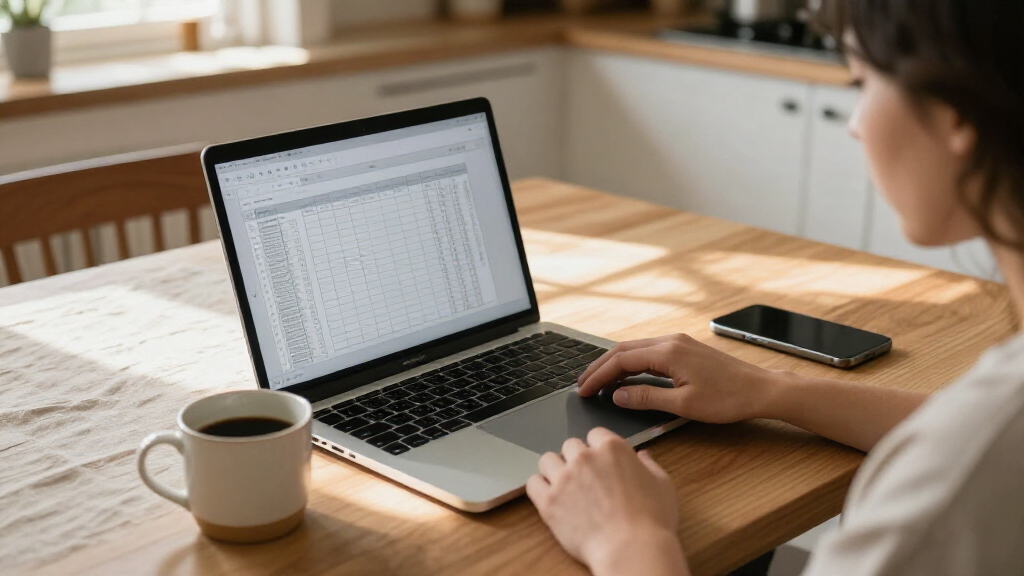
How We Picked
I ranked these laptops around the tasks that make up personal finance work: editing spreadsheets, keeping banking and bill-payment pages open, handling email, and storing household documents. The listed memory and storage configurations carried the most weight because 4GB of RAM can constrain multitasking, while SSD capacity affects how much can be stored locally. I also compared screen size, keyboard-oriented details, processor listings, operating system edition, and included accessories where specified. I did not assume unlisted features or treat a model name alone as proof of performance.
The order favors balanced configurations that give a typical household more room for everyday work, followed by options with a distinct advantage or a clear limitation. That puts the IdeaPad Slim 3i first for its combination of 8GB RAM and a full-size display, with the V15 G6 close behind for its 256GB SSD and DDR5 memory. The DRKAKO and Celeron models offer useful listed features, but buyers should weigh their tradeoffs against the Lenovo choices. The 4GB HP models rank lower for multitasking, though their different sizes and software configurations may still suit simpler routines.
| budgeting laptops for personal finance | Operating system | Wireless | Battery life |
|---|---|---|---|
| HP 15.6-Inch Laptop with Intel | Windows 11 Home | Wi-Fi 6 and Bluetooth 5.4 | Up to 8 hours 15 minutes mixed use |
| HP 15.6-Inch Laptop with Intel | Windows 11 Home in S mode | Wi-Fi 6 and Bluetooth 5.4 | Up to 10 hours 45 minutes video playback; up to 7 hours 30 minutes wireless streaming |
| 15.6-Inch FHD Laptop with Inte | Windows 11 Pro | Wi-Fi 5 and Bluetooth 5 | — |
| Lenovo V15 G6 15.6-Inch FHD La | Windows 11 Home | Wi-Fi 6 and Bluetooth 5.2 | — |
| DRKAKO 15.6-Inch FHD IPS Lapto | Windows 11 Home | Wi-Fi 5 and Bluetooth 4.2 | Up to 6 hours |
| HP 14-Inch Laptop with Intel N | Windows 11 Pro | — | — |
| HP 14-inch Laptop | Windows 11 Home | Wi-Fi 6 (2×2), Bluetooth 5.4 | Up to 11 hours of video playback |
| Lenovo IdeaPad Slim 3i 15.6-In | Windows 11 Home | Wi-Fi 6, Bluetooth 5.2 | — |
Factors to Consider When Choosing Budgeting Laptops For Personal Finance
Personal finance usually needs less computing power than video editing or gaming, but comfort and reliability matter when the laptop is part of a regular bill-paying routine. I would choose around the way you work: how many browser tabs stay open, whether you save records locally, and whether you move between rooms or take the laptop out of the house.
Choose Memory for Your Real Multitasking Habits
A finance routine can involve a spreadsheet, online banking, email, and a document folder at the same time, so memory affects ease of use even when each task is simple. The 8GB and 12GB configurations in this roundup offer more headroom for that pattern than the 4GB models. A common mistake is to judge a laptop only by its processor name while overlooking how much memory is available. If you normally use one browser tab and one finance app at a time, 4GB may be workable, but it leaves less room for changing habits or background tasks. Buyers who keep many tabs open should favor a higher-memory configuration before paying for extras they will rarely use.
Match Storage to Your Record-Keeping Style
Cloud storage can reduce the need for a large internal drive, but it does not remove the value of local space for downloaded statements, tax files, and backups. Among the listed configurations, 256GB SSD models provide more stated capacity than the 128GB UFS options. Storage type and capacity are separate questions: capacity sets how much fits, while the drive type can affect everyday file access. Avoid assuming that every financial record belongs only on the laptop; a separate backup or reputable cloud service can protect against device loss or failure. If you keep years of documents locally, make storage and backup plans part of the purchase rather than an afterthought.
Pick a Screen Size That Fits Your Workspace
A larger display can make a budget spreadsheet easier to scan because more rows and columns may fit onscreen. The 15.6-inch choices in this roundup suit desk-based use, while the 14-inch HP models trade some workspace for a smaller footprint. Screen size alone does not tell you how comfortable a panel will be, so check resolution and panel details when the listing provides them. Buyers who work with dense spreadsheets may also benefit from an external monitor, which can be a better use of a limited budget than paying for a premium laptop tier. If portability comes first, accept that you may scroll or zoom more often.
Treat Keyboard and Login Features as Daily-Use Tools
Budgeting often means entering figures, labeling transactions, and writing notes, so keyboard comfort can matter more than a small processor difference. A backlit keyboard can help in dim rooms, while a fingerprint reader may make sign-in more convenient; those features are listed on the Celeron-based FHD laptop in this group. They do not replace a strong password or sound account security habits, and buyers should check whether the feature is included in the exact configuration they plan to buy. Try to confirm keyboard layout, number-pad availability, and touchpad details if you spend long sessions entering data. These practical checks can prevent a low-cost laptop from feeling tiring during routine finance work.
Do Not Confuse an Operating System Edition With Better Finance Performance
One HP 14-inch listing specifies Windows 11 Pro, while other models list Windows 11 Home or do not state an edition in the supplied product name. An edition label can matter for work or administration needs, but it does not by itself make spreadsheets run faster or banking sites safer. Personal finance users should focus on receiving supported software updates, using a unique password, and enabling multifactor authentication where available. Check the exact operating system and included software before buying, especially when listings bundle accessories or use similar model names. Pay extra for an edition only when you can name a feature you will actually use.
Plan for Security, Backups, and Long-Term Use
A laptop used for money management holds sensitive account access and personal records, so device care matters beyond the initial hardware choice. Keep the operating system and browser updated, use a password manager or unique passwords, and avoid entering financial credentials on public or shared devices. Back up tax files and statements to a separate location so one damaged or misplaced laptop does not erase your records. A low-memory configuration may feel limiting sooner if your routine grows to include more tabs and apps, while a larger drive helps only if you also manage backups. When deciding whether to spend more, prioritize the upgrade that addresses a real constraint in your routine rather than buying specifications for their own sake.
Frequently Asked Questions
Is 4GB of RAM enough for checking accounts and maintaining a basic budget?
It can handle a simple routine that uses a small number of browser tabs and one main finance task at a time. The limitation becomes clearer when banking pages, a spreadsheet, email, and other tabs stay open together. In this lineup, the 4GB HP models have less multitasking headroom than the 8GB Lenovo options and the 12GB DRKAKO. If you expect your routine to grow or dislike closing tabs, favor a higher-memory configuration. For occasional, single-task use, 4GB may still fit your needs.
Should I choose a 256GB SSD or 128GB of UFS storage for finance records?
Choose based on how much you plan to keep on the laptop, not just the number on the listing. A 256GB drive gives more local room for downloaded statements, tax documents, and other files than a 128GB configuration. If most records live in cloud storage and you keep local copies modest, 128GB may be sufficient, though it leaves less flexibility for general files and apps. Also check the exact storage type and configuration before purchase, since capacity alone does not describe every aspect of drive behavior. Whichever you pick, keep a separate backup of important records.
Is a 14-inch laptop too small for working with budget spreadsheets?
Not necessarily: a 14-inch screen can work well for basic budgets, especially if portability matters and you are comfortable scrolling or zooming. A 15.6-inch screen generally gives more room to view spreadsheet columns and other windows at once. Screen size does not guarantee a particular resolution or display quality, so check the full listing rather than relying on the diagonal measurement alone. You can also connect an external monitor at home if the laptop supports the connection you need. Pick the smaller format for easy carrying and the larger one for a more spacious built-in workspace.
Does Windows 11 Pro make a laptop a better choice for personal finance?
Not automatically. The Pro edition may be useful for specific work or device-management features, but it does not by itself improve spreadsheet performance or protect an account from phishing. For personal finances, updated software, strong unique passwords, and multifactor authentication usually matter more to everyday account safety. The HP 14-inch Pro listing may suit someone who already needs that edition, while a Home configuration can be enough for common household tasks. Verify the exact operating system edition and included features before deciding whether that distinction is worth paying for.
When should I pay more for a laptop with more memory or storage?
More memory is the stronger priority if you keep many tabs and apps open, because it can give everyday multitasking more room. More storage makes sense if you retain lots of documents locally, but cloud storage and a separate backup can reduce that need. In this roundup, the 8GB Lenovo models and 12GB DRKAKO offer more listed memory than the 4GB HP options, while the 256GB SSD configurations offer more capacity than the 128GB options. Do not pay for a larger specification just because it sounds future-proof; connect it to a habit or limitation you already have. A balanced configuration often serves a finance routine better than spending on an upgrade with no clear use.
Conclusion
Best overall: I’d choose the Lenovo IdeaPad Slim 3i for a balanced mix of 8GB RAM and a 15.6-inch display. Best value: the Lenovo V15 G6 is my pick for buyers who want 8GB DDR5 memory and a 256GB SSD in one configuration. Best premium-style feature set: the DRKAKO stands out for its listed 12GB of RAM, though buyers should weigh that against their brand preferences and verify the exact configuration. Best for beginners: a 15.6-inch HP with 4GB RAM can suit someone who handles simple, one-task-at-a-time budgeting, but I’d choose 8GB for frequent multitasking. Best for specific needs: choose an HP 14-inch model if carrying a smaller laptop matters, or the Celeron-based FHD laptop if its listed backlit keyboard and fingerprint reader match your daily routine. For most buyers, the decision comes down to whether a larger screen and stronger multitasking matter more than a compact design or a simpler setup.