
TL;DR

Get smart everyday buys delivered free with Prime
- Fast, free delivery on millions of items
- Prime Video, Amazon Music and more included
- Member-only deals all year
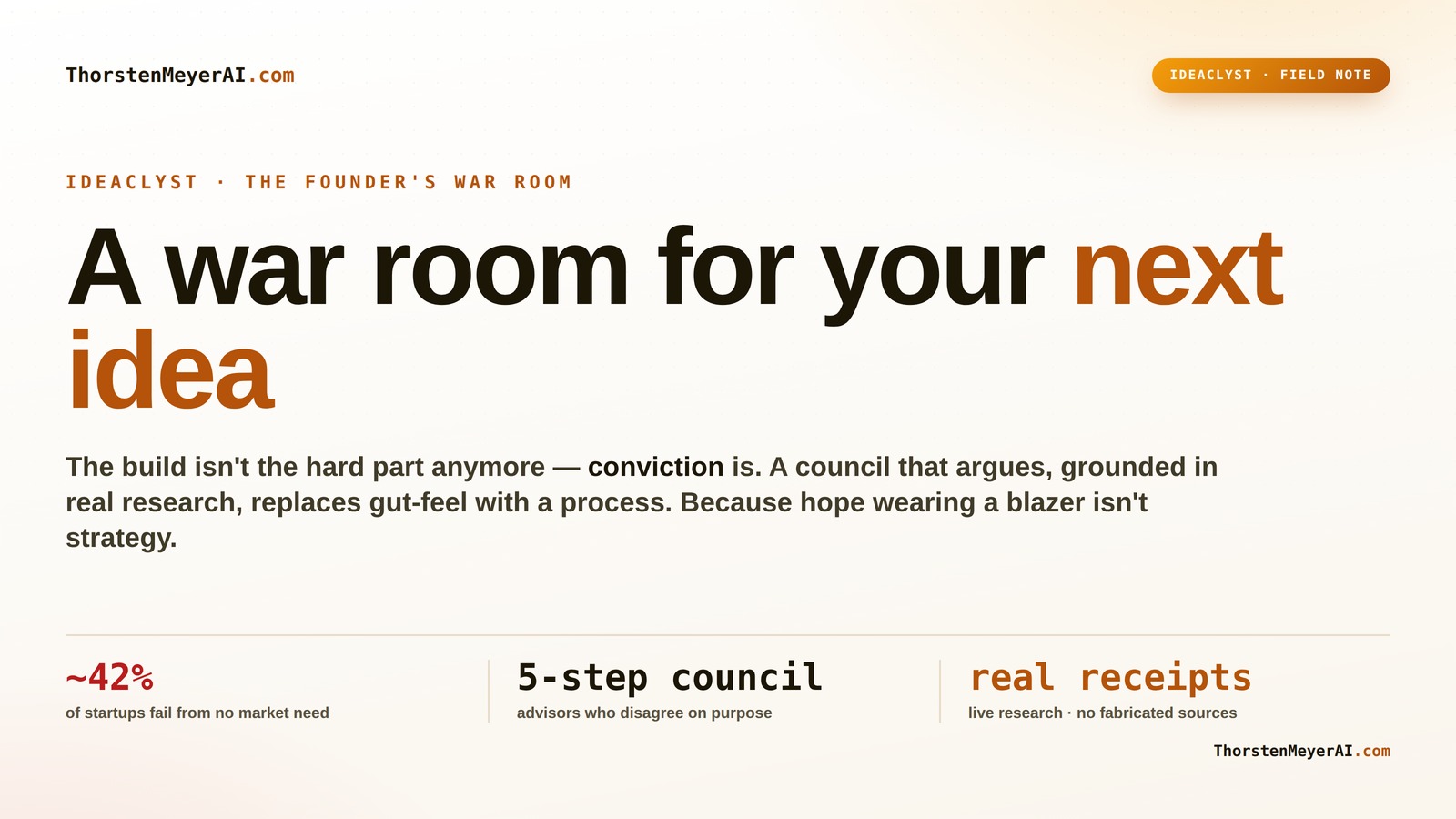
IdeaClyst acts as a digital war room, giving founders a structured space to test, debate, and refine ideas using AI councils grounded in real research. It saves time, reduces risk, and keeps your data private on your own machine.
A war room for your next idea
The build isn’t the hard part anymore — conviction is. Knowing which idea deserves the next six months, and being able to defend it. Most founders answer with gut feel and optimistic math. That’s hope wearing a blazer. IdeaClyst replaces it with a process.
The most expensive decision is what to build
The single most valuable thing a tool can do is talk you out of the wrong six months. The numbers make the case better than any pitch.
Three tools in one — on your own machine
Strip away the framing and IdeaClyst is three things at once, all running locally with nothing leaving your laptop.
An AI council
Pressure-tests an idea you bring it — advisors who argue on purpose.
A discovery engine
Finds ideas you didn’t know to look for by hunting real demand signals.
A founder’s workspace
Carries winners from “interesting” all the way to “ready to build.”
Advisors who disagree on purpose
Not one confident, agreeable answer — a structured five-step deliberation where models play different roles and turn on their own work. The disagreement is the feature.
The five-step deliberation
A council that leads with the bad news surfaces the objections you’d otherwise find the expensive way, on month five.
Product strategy
Who’s it for, what’s the wedge, why now, what’s the business model.
Technical architecture
What would it actually take to build — and where’s the risk.
Critique pass
The council turns on its own work. Where’s the hand-waving? What kills this?
Second, independent critique
A different voice, a different angle — so blind spots don’t survive.
Final synthesis
Everything into one coherent founder packet: strategy, architecture, validation, plan.
When IdeaClyst cites a source, it actually fetched it
The hard departure from “ask an AI what it thinks of my startup.” It runs in a strict, real-data-only mode — if it can’t gather genuine evidence, it says so plainly rather than inventing a plausible paragraph.
Confidence with receipts
No fabricated statistics, no imaginary competitors, no made-up citations. The packet survives a skeptical co-founder or a sharp investor because the reasoning has receipts.
Market research first
Scouts the landscape before the council reasons about anything.
Competitor read
Real positioning, pricing signals, feature claims — differentiation vs. reality.
Validation with links
Not “talk to customers” — concrete signals & sources you can click.
From the blank page to build-ready
Evaluation is half the problem; the blank page is the other half. And a plan is worthless if it dies in a tab you never reopen.
Bring a space, not an idea
“AI for accountants,” “tools for indie game studios” — plus your goal and real capacity. It hunts demand signals across HN, Reddit, Product Hunt, GitHub, pricing pages.
- An honest market read — leads with the bad news when a space is hard
- An opportunity map — high pain, thin competition
- Ranked candidates — wedge, who pays, effort, risk, confidence
- each with KILL CRITERIA — when to walk away
A home and a forward path
Every promising idea gets carried forward, with every artifact in plain files on your disk.
- Validation tooling — sprint board, interview list, evidence browser
- Founder profile — a personal-fit lens; same discovery, different advice
- Build workspaces — funnel, personas, landing draft, version history
- “Build this idea” → a PRD + task queue, ready for a coding agent
Key Takeaways
- IdeaClyst’s local-first design keeps your proprietary ideas private and secure, avoiding cloud vulnerabilities.
- The structured AI council debates from multiple angles, surfacing blind spots and building confidence.
- Grounding analyses in real-time web research reduces the risk of building for a shrinking or misjudged market.
- A digital war room like this turns fuzzy ideas into clear, actionable plans—saving weeks of confusion.
- Regularly updating and revisiting your idea files keeps your war room alive and your strategy sharp.
As an affiliate, we earn on qualifying purchases.
Why a War Room Matters More Than Ever for Your Ideas
Think of a war room as the command center for your startup’s strategy. It’s where clarity, focus, and momentum come together. Historically, these spaces—physical or digital—help teams see the big picture and make quick decisions.
Today, a digital war room like IdeaClyst takes that concept to the next level. It’s a centralized hub for your idea’s entire journey—from brainstorming to validation—visible and accessible whenever you need it. For example, a founder testing a new SaaS feature can keep all research, critiques, and plans in one spot, updating as they go.
Recent trends show that teams that maintain a dedicated space for idea development are 30% more likely to succeed. Discover related strategies for organizational productivity. The reason? Continuous visibility and ongoing debate keep ideas sharp and aligned with real market needs. This emphasizes the importance of having a dedicated, organized environment—because scattered notes or ad hoc discussions can lead to overlooked risks or missed opportunities. A war room consolidates these activities, enabling faster pivots and more informed decisions, ultimately reducing costly mistakes and accelerating innovation.
private AI research tool for startups
As an affiliate, we earn on qualifying purchases.
As an affiliate, we earn on qualifying purchases.
What Makes IdeaClyst Different from Any Brainstorming App
IdeaClyst isn’t just another note-taking tool or project management board. It’s a complete digital war room built around a structured AI council. Unlike simple brainstorming apps, it actively debates your idea from multiple angles—strategy, tech, risks—and surfaces blind spots you might miss.
It’s like having a panel of experts inside your laptop, each playing a different role. Explore how structured debate tools can enhance decision-making. The AI council stages five structured steps: strategy, architecture, critique, second critique, and synthesis. This process isn’t just about generating ideas; it’s about rigorously testing their viability, uncovering hidden flaws, and refining concepts into actionable plans. This structured debate ensures that your ideas aren’t just thought experiments but are critically evaluated from multiple perspectives—an essential practice for reducing bias and oversight.
This local-first approach means your raw ideas stay private, and you own every piece of the process. You can even version-control your insights and integrate them into your pitch deck without fuss. The tradeoff here is that while cloud-based tools offer convenience, they often sacrifice privacy and can introduce latency or security concerns. IdeaClyst’s design prioritizes control, which is crucial when dealing with sensitive or proprietary information, especially in competitive or regulated industries.
collaborative idea testing software
As an affiliate, we earn on qualifying purchases.
As an affiliate, we earn on qualifying purchases.
How the AI Council Debates Your Idea Like a Team of Disagreeing Experts
The core of IdeaClyst’s power is its council—five models that argue, critique, and refine your idea. Instead of one AI telling you what it thinks, you get a structured debate. First, the council defines who the product is for, the business model, and market timing—what’s called the strategy phase.
Next, it tackles the technical build: what’s needed, the risks, and potential pitfalls. Then, it critiques itself, hunting for assumptions, gaps, and weak spots. A second, independent critique ensures no blind spot escapes scrutiny. Finally, a synthesis combines all feedback into a clean plan, ready for action.
This layered, multi-model debate isn’t just for thoroughness—it mimics how a diverse team of experts would approach a complex problem, each bringing their own perspective and skepticism. See how collaborative tools improve innovation. This process helps you identify overlooked flaws, challenge your assumptions, and refine your strategy into a more resilient plan. The tradeoff is that this structured approach requires more upfront engagement, but the payoff is a much higher confidence level in your final decision, reducing the risk of costly mistakes down the line.
As an affiliate, we earn on qualifying purchases.
Grounded in Real Research—Why That Matters for Your Confidence
Many AI tools give vague, confidence-boosting vibes without evidence. IdeaClyst breaks that mold. It’s grounded in live web research, pulling real-time data to support every critique and recommendation.
For example, if you suggest targeting a niche market, the council checks actual trends, competitor data, and customer behavior—updating continuously. This approach ensures your decisions are based on current, relevant information rather than outdated assumptions or gut feelings. It’s akin to having a dedicated research team analyzing market shifts as you work, which can make or break a product’s success.
This focus on evidence means you can trust the final plan more—whether you’re pitching investors or deciding whether to build. Making decisions based on verified data reduces the likelihood of pursuing ideas with no real market fit, saving time and resources. Learn more about IdeaClyst’s research-driven approach. It also encourages a mindset of continuous learning and adaptation—because the data is always fresh, your strategies stay aligned with evolving market conditions. According to industry data, decisions rooted in real-time research are over 20% more likely to succeed, highlighting the importance of this approach in competitive landscapes.
Learn more about how research fuels smart decisions at [IdeaClyst](https://ideaclyst.com) and explore other research-based tools at [Thorsten Meyer AI](https://thorstenmeyerai.com/).
Why Local-First Matters—Keeping Your Data Yours
IdeaClyst runs entirely on your machine—no cloud, no data sharing. It writes everything as plain files on your disk, giving you complete control. This local-first approach isn’t just a tech preference; it’s a shield against data leaks and privacy concerns.
For example, if you’re working on a highly sensitive healthcare app idea, you won’t risk exposing proprietary concepts by uploading to cloud servers. Everything stays securely in your control.
In a world where data breaches make headlines weekly, this feature is a game-changer. It also means you can work offline, anywhere—no internet required, no dependencies. Visit IRA-focused investment sites for secure data management. This setup minimizes potential attack vectors, ensuring your confidential insights remain protected from external threats, which is especially critical when dealing with proprietary or regulated information. The tradeoff is that you need to be comfortable managing your own data files and updates, but for those prioritizing privacy, it’s a worthwhile exchange.
Check out the details at [IdeaClyst](https://ideaclyst.com) and see how your ideas stay private and portable.
Turning Your Idea Into a Clear, Actionable Plan
Most founders struggle to move from a vague concept to a concrete plan. IdeaClyst’s final step synthesizes all the feedback into a tidy, Markdown-based founder packet. This document includes strategy, architecture, critiques, validation tests, and next steps—all in one place.
This synthesis is more than just compiling notes; it’s about distilling complex debates and diverse insights into a coherent narrative that guides your next steps with clarity. It helps you see the logical flow from idea to implementation, ensuring nothing gets lost in translation. The benefit is that it reduces the cognitive load, allowing you to focus on execution rather than reconciling scattered information. The plan is version-controlled, so you can track changes, revisit earlier iterations, and maintain a clear history of your decision-making process. This structured output turns fuzzy ideas into sharp, actionable strategies—saving you weeks of confusion and indecision.
Practical Tips to Maximize Your War Room’s Power
- Regularly revisit your idea files to keep your war room alive and relevant.
- Use the council’s critiques as a checklist—don’t skip the unpleasantries.
- Keep your research updated—data is your best defense.
- Version-control your markdown files—think of it as a time machine for ideas.
- Treat your local machine as a trusted collaborator—update and refine often.
Frequently Asked Questions
Is IdeaClyst suitable for early-stage startups?
Absolutely. It’s designed to help founders validate ideas quickly and privately. You can test assumptions, debate strategies, and build confidence before committing resources.Do I need technical skills to use IdeaClyst?
Not really. While some comfort with Markdown and basic command-line tools helps, the core features are user-friendly. Plus, it’s open source and runs on your machine, so no complex setup is needed.Can I use IdeaClyst for team collaboration?
While it’s primarily a personal workspace, you can share your idea files safely with teammates or collaborators. It’s perfect for solo founders or small teams who want control over their data.How does IdeaClyst compare to traditional brainstorming tools?
Traditional tools are often static and disconnected. IdeaClyst’s strength lies in its structured debate, real research grounding, and local-first privacy—turning scattered ideas into a decisive plan.What’s the best way to start with IdeaClyst?
Begin by writing a simple idea prompt, then run it through the AI council. Use the critiques to refine your concept and generate a clear plan. The more you engage, the sharper your decision-making becomes.Conclusion
Your next big idea deserves a space where it can be challenged, refined, and proven. IdeaClyst isn’t just software—it’s your private war room, built to make bold decisions with confidence. Keep your ideas close, debate fiercely, and turn uncertainty into your secret weapon.Fall Picks
fall essentials
As an affiliate, we earn on qualifying purchases.