

Beginners choosing a financial planning book often face a practical question: should the first read teach them how to invest, or help them organize their entire financial life? The Simple Path to Wealth by JL Collins is the narrower, more investing-focused choice. I Will Teach You to Be Rich by Ramit Sethi takes a broader approach, combining a spending plan, account automation, debt guidance, and investing into a set of routines.

Get smart everyday buys delivered free with Prime
- Fast, free delivery on millions of items
- Prime Video, Amazon Music and more included
- Member-only deals all year

Personal Finance For Dummies
- ✔ Format: Book
- ✔ Subject: Personal finance
- ✔ Intended reader: General personal-finance audience
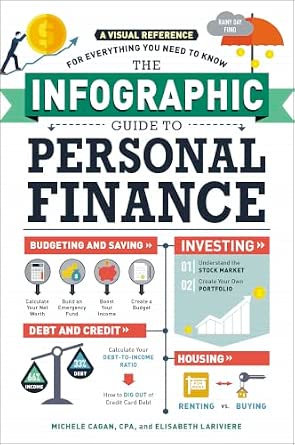
The Infographic Guide to Personal Finance: A Visual Reference for Everything You Need to Know
- ✔ Format: Visual reference guide
- ✔ Subject: Personal finance
- ✔ Series: Infographic Guide Series

Financial Literacy for Young Adults Simplified
- ✔ Format: Book
- ✔ Subject: Financial literacy
- ✔ Intended reader: Young adults
Neither is a full substitute for personalized financial advice, and their recommendations reflect particular philosophies rather than rules for every household. The key tradeoff is focus versus coverage: Collins makes the case for keeping investing simple, while Sethi gives beginners more help turning money intentions into recurring actions. Choose Collins if you mainly want a clear investing framework; choose Sethi if you need a practical starting system for several money tasks at once.
At a Glance
| Criteria | The Simple Path to Wealth by JL Collins | I Will Teach You to Be Rich by Ramit Sethi | Winner |
|---|---|---|---|
| Primary focus | Long-term investing, financial independence, and keeping the plan simple | A working personal finance system spanning spending, saving, debt, and investing | Depends |
| Investing instruction | Strong focus on investing principles, market risk, and a low-cost index-fund approach | Practical investing guidance within a wider financial plan | A |
| Budgeting and spending | Less attention to building a detailed spending plan | More direct help deciding how to spend, save, and prioritize | B |
| Automation and implementation | Offers a broad philosophy, with fewer step-by-step routines for the full money system | Emphasizes automating recurring money tasks and putting the plan into practice | B |
| Beginner accessibility | Straightforward if the reader wants to focus on investing; narrower if they need a complete starting checklist | Accessible to many beginners, though its volume of steps and examples may feel like a lot | Depends |
| Coverage of financial planning | Selective: investing and financial independence are central, while other planning topics get less space | Broader beginner coverage, but not a personalized financial plan | B |
| Best fit for | Readers who want a focused investing guide and can manage other financial tasks separately | Readers who want an actionable structure for organizing several parts of their finances | Depends |
Personal Finance For Dummies
For readers who want a first book without committing to one narrow topic, Personal Finance For Dummies is our most flexible choice. Its general personal-finance positioning makes it the natural starting point when we are still figuring out whether our next priority is budgeting, saving, investing, or another money decision. The supplied information does not specify its chapter list, so we would not assume that it treats every subject in equal depth; its advantage here is its broad beginner-facing role rather than a verified feature checklist.Compared with The Infographic Guide to Personal Finance, this title is the better fit for readers who want a conventional, broad introduction rather than a book specifically framed as a visual reference. It also has a wider potential audience than Financial Literacy for Young Adults Simplified, whose stated focus is younger readers and financial independence. That versatility helps it take the top spot, but it also means readers seeking a strongly visual format or advice framed explicitly for young adults may feel the other books speak to them more directly.We would choose it as a first stop for building a general foundation, then use more specialized resources when a particular question requires detail. Since the supplied description is limited, we cannot confirm particular exercises, examples, or planning tools. Its strength is broad accessibility as a starting point; readers who want a tightly tailored guide or a clearly diagram-led presentation should compare the other picks before deciding.
Pros:
- Broad personal-finance positioning suits readers exploring different beginner questions.
- Flexible starting point when we are unsure which area of money management to prioritize.
- More general-audience fit than the explicitly young-adult-focused option.
- A useful counterpart to specialized visual or age-focused guides.
Cons:
- The supplied details do not identify specific topics, tools, or chapter depth.
- Its general positioning may feel less tailored than the young-adult guide.
- It is not explicitly described as a visual reference for readers who prefer diagrams.
Best for: Beginners who want a general personal-finance starting point and have not yet decided which money topic to tackle first.
Not ideal for: Readers who specifically want a visual reference, or young adults looking for a guide framed around their life stage and financial independence.
Bottom line: We rank Personal Finance For Dummies first for its adaptable beginner role, while noting that readers with a strong format or age-group preference may get a closer fit elsewhere.
“We rank Personal Finance For Dummies first for its adaptable beginner role, while noting that readers with a strong format or age-group preference may get a closer fit elsewhere.”
The Infographic Guide to Personal Finance: A Visual Reference for Everything You Need to Know
The Infographic Guide to Personal Finance is the most clearly differentiated book in this lineup: it presents personal finance as a visual reference rather than a general-purpose title or an age-specific guide. For beginners who find dense explanations difficult to absorb, that format may make it easier to approach a topic at a glance and connect ideas visually. The description also identifies broad personal-finance coverage, so it is not limited to a single money skill.Compared with Personal Finance For Dummies, this pick is less about being the most adaptable general entry and more about how information is presented. That makes it a better match when visual learning is a priority, but the supplied details do not establish how much explanation accompanies each graphic. Readers who want sustained, detailed instruction should consider whether a reference-led format gives them enough context. Compared with Financial Literacy for Young Adults Simplified, it has a broader audience and is not described as specifically centered on young adults.The book belongs to the Infographic Guide series, which reinforces its visual-reference identity. We would choose it for quick orientation across personal-finance subjects, not assume it substitutes for personalized advice or an in-depth course. Its role is deliberately distinct: format is the deciding advantage, and potential lack of prose depth is the tradeoff. If we learn best by reading extended explanations, the broad introductory option may be a safer first choice.
Pros:
- Visual-reference format gives it a distinct learning approach in this comparison.
- Covers personal finance broadly according to the supplied description.
- May suit readers who prefer scanning visual material to starting with dense prose.
- Part of the Infographic Guide series.
Cons:
- The supplied details do not confirm how much written explanation accompanies the visuals.
- A reference format may not provide the depth some beginners want for complex decisions.
- Not specifically described as tailored to young adults or a particular life stage.
Best for: Beginners who absorb information more easily through visual references and want a broad personal-finance overview.
Not ideal for: Readers who prefer extended prose instruction, detailed step-by-step planning, or a guide explicitly aimed at young adults.
Bottom line: We recommend this title when visual learning matters more than a conventional broad introduction, with the caveat that the available details do not establish its depth.
“We recommend this title when visual learning matters more than a conventional broad introduction, with the caveat that the available details do not establish its depth.”
Financial Literacy for Young Adults Simplified
Where the first two titles offer either a broad personal-finance entry point or a visual reference, Financial Literacy for Young Adults Simplified narrows the audience deliberately. Its description identifies young adults and names money management, saving, and investing, with the aim of helping readers build a secure, financially independent future. That makes it the clearest match for someone who wants a beginner guide framed around the transition toward managing money independently.This focus is also the book’s main limitation. Personal Finance For Dummies has a more general-audience role, so it may suit a household or reader who wants an all-purpose starting point better. The Infographic Guide is the more obvious pick if the learning format matters most. The supplied description for this young-adult title does not specify its presentation, level of detail, or whether it covers planning subjects beyond its named areas. We should treat its listed topics as the confirmed scope rather than infer additional features.For a younger beginner, the emphasis on managing money, saving, and investing gives the book a clearer sense of audience than the other two. It may be less suitable for readers outside that stage of life or for someone seeking a comprehensive reference across many financial decisions. We rank it third overall because its audience fit is strong but narrower; for the right reader, that specificity may matter more than our overall order. Choose it for its young-adult focus, not as a universal guide for every beginner.
Pros:
- Explicitly aimed at young adults rather than a general audience.
- Names money management, saving, and investing among its topics.
- Connects beginner financial habits with the goal of financial independence.
- Offers a more life-stage-specific angle than the other two picks.
Cons:
- Its intended audience is narrower than the general personal-finance option.
- The supplied details do not specify format, chapter depth, or planning tools.
- The description does not establish coverage beyond its named subject areas.
Best for: Young adults beginning to manage their own finances who want a guide focused on money management, saving, investing, and financial independence.
Not ideal for: Readers who want the broadest general-purpose reference, a specifically visual guide, or material not framed around young adulthood.
Bottom line: We recommend this book to young adults who want money guidance framed around independence, but readers seeking a broader reference should start with another pick.
“We recommend this book to young adults who want money guidance framed around independence, but readers seeking a broader reference should start with another pick.”
As an Amazon Associate we earn from qualifying purchases.
Key Differences
The books start from different problems. Collins addresses the difficulty and anxiety many people attach to investing: his answer is to understand a small number of principles, favor a simple long-term approach, and avoid treating market movement as a reason to constantly change course. That makes his book especially useful when a beginner has the basics of cash flow under control but does not know how to think about investing. It is less suited to someone whose immediate challenge is unpaid debt, unclear spending, or getting financial tasks done regularly.
Sethi takes a wider, more procedural route. The book helps readers organize money decisions across spending, saving, debt, and investing, with automation as a way to reduce repeated effort. That breadth gives a beginner a more useful first framework when several parts of their finances feel disconnected. The tradeoff is that more topics and steps can mean more to sort through, and a broad system cannot account for every reader’s circumstances. In short: Collins wins on investing focus; Sethi wins on whole-system implementation.
Detailed Comparison
Primary focus (moderate difference)
Collins wins if the decision is specifically about learning how to invest. The Simple Path to Wealth keeps returning to a focused long-term investing philosophy, making the central message easier to isolate and remember. Sethi covers investing too, but places it alongside spending, saving, and debt. The difference is moderate: readers who already understand the rest of their finances may prefer Collins’s tight scope, while readers who need a wider foundation will get more from Sethi.
Investing instruction (The Simple Path to Wealth by JL Collins wins — moderate)
Collins has the advantage for readers whose main question is what investing approach to follow and why. The book gives investing more room and builds around simplicity, long horizons, and a low-cost index-fund philosophy. Sethi provides useful investing guidance, but it is one part of a larger plan rather than the sole focus. This is a moderate difference, not a claim that one book can select investments suited to every person: choose Collins for a concentrated explanation, and seek additional guidance if your tax, work, or family situation calls for more specific advice.
Budgeting and spending (I Will Teach You to Be Rich by Ramit Sethi wins — major)
Sethi wins by a clear margin for beginners who need help directing income before they invest it. His wider framework gives more attention to spending choices and how to divide money among priorities. Collins’s principal strength is the investing case, not building a detailed household spending plan. The practical difference is meaningful: someone unsure where their paycheck goes is likely to find Sethi more useful as a first read, while a reader with a working budget may not need that extra coverage.
Automation and implementation (I Will Teach You to Be Rich by Ramit Sethi wins — moderate)
Sethi wins moderately on turning ideas into recurring actions. His approach gives readers more direction for organizing accounts and automating routine money tasks, which can help reduce the burden of deciding what to do every month. Collins supplies a compelling philosophy, but it is less of a complete implementation checklist across a household’s finances. Readers who already have effective routines may see little difference; beginners who tend to postpone financial admin may value Sethi’s more operational style.
Beginner accessibility (minor difference)
This is a close call, because the easier book depends on what the reader finds confusing. Collins is easier to follow when the subject is investing: a concentrated argument reduces the number of competing topics. Sethi is more helpful when the reader wants concrete direction across multiple tasks, but its wider scope can feel like more material to process. The gap is minor. Pick the book whose subject matches the question you are trying to solve, rather than assuming that narrower automatically means easier.
Coverage of financial planning (I Will Teach You to Be Rich by Ramit Sethi wins — moderate)
Sethi wins for breadth, with a moderate advantage. It speaks to several connected parts of a beginner’s financial life rather than centering almost entirely on investing. That makes it a stronger single-book starting framework for a reader who wants to connect daily choices with saving and investing. It still is not comprehensive personal financial advice: readers may need other resources for taxes, insurance, estate planning, benefits, or circumstances that require individualized analysis. Collins is more explicitly focused, which is a benefit if breadth would distract from the reader’s actual question.
Value for a first purchase (moderate difference)
There is no universal winner because value depends on whether the reader needs focus or range. If investing is the missing piece, Collins gives more concentrated coverage without making the reader work through a broader program. If the reader needs help with several parts of money management, Sethi can deliver more practical range in one purchase. The difference is moderate: neither is automatically worth paying more for in every edition or market. Compare current formats and prices, and pay extra for Sethi’s breadth only when you expect to use the wider system.
The Simple Path to Wealth by JL Collins: Pros and Cons
Pros:
- Concentrates on long-term investing, making its central message easy to identify.
- Useful for beginners seeking a clear explanation of a simple, low-cost investing philosophy.
- Avoids spreading its main argument across a full household money-management program.
Cons:
- Gives less help with budgeting, debt priorities, and organizing day-to-day finances.
- May not provide enough implementation detail for readers who need routines across multiple accounts and goals.
- Its focused philosophy should not be mistaken for tailored advice about every investor’s circumstances.
I Will Teach You to Be Rich by Ramit Sethi: Pros and Cons
Pros:
- Connects spending, saving, debt, and investing in a broader beginner framework.
- Offers more direction for automating routine money tasks and putting a plan into practice.
- A strong first choice when a reader’s finances feel disorganized across several areas.
Cons:
- The wider scope can feel more involved than a focused investing book.
- Readers seeking only an investing explanation may find some material outside their immediate needs.
- A general system cannot replace advice tailored to a person’s tax situation, benefits, or household needs.
Who Should Choose What
Choose The Simple Path to Wealth by JL Collins if:
- Your main question is how to approach long-term investing, and your spending and debt routines are already reasonably organized.
- You prefer a focused book with a central investing philosophy over a broader money-management program.
- You want to understand the case for keeping an investment plan simple rather than managing many moving parts.
Choose I Will Teach You to Be Rich by Ramit Sethi if:
- You need help connecting spending, saving, debt, and investing rather than solving only an investment question.
- You are more likely to follow through when money tasks are organized into routines and automated where appropriate.
- You want one practical beginner framework to help organize several parts of your finances.
Skip both if: Neither book is enough if you need advice tailored to complex taxes, business ownership, a major life change, or legal and estate matters. Use a qualified professional for personalized guidance, and use either book as general education rather than a prescription.
Value for Money
For most true beginners who have not yet organized their money, I Will Teach You to Be Rich is the stronger first-book value because its broader coverage can help address more than one problem at once. That extra range is worth paying more for only if the reader will use the spending, saving, debt, and automation guidance. If those areas are already in good shape and the missing piece is investing, the added breadth has little practical value: The Simple Path to Wealth is the better match, and a premium for a wider program would be unnecessary.
Prices vary by edition, format, and retailer, so compare the versions available rather than assuming one title always costs more. The best value is the book that addresses the next real decision in your financial life, not the one with the longest checklist or the most ambitious promise.
Final Verdict
For a beginner who wants one book to organize several parts of personal finance, choose I Will Teach You to Be Rich. Its broader approach makes it the more useful starting point for readers who need to make spending, saving, debt, and investing work together, especially if automation would help them follow through. It is the better general-purpose pick, though it cannot replace personalized professional advice.
Choose The Simple Path to Wealth instead if your financial basics are in place and investing is the specific gap. It offers a more concentrated treatment of a simple long-term investing philosophy, without asking you to work through a wider household finance system. The biggest deciding factor is your immediate problem: choose Sethi for a money-management framework; choose Collins for investing focus. If you can buy only one and are unsure where to start, Sethi is the safer first choice for most beginners.
Frequently Asked Questions
Which book is better for someone who has never invested?
If investing is your only question, The Simple Path to Wealth is the more focused introduction to a long-term investing philosophy. If you also need to sort out spending, saving, or debt, I Will Teach You to Be Rich is a more useful first read because it places investing within a broader plan.
Does I Will Teach You to Be Rich cover investing as well as budgeting?
It covers investing alongside spending, saving, debt, and money routines, so it offers more breadth than a dedicated investing guide. That does not make it individualized investment advice; readers with unusual tax, work, or family circumstances may need a qualified professional or more specialized resources.
Is The Simple Path to Wealth a complete financial plan?
No. It is best understood as a focused investing and financial independence book, not a guide to every area of household planning. Readers may need separate help with budgeting, insurance, taxes, estate matters, or debt decisions not addressed in enough detail for their situation.
Should I read both books?
Reading both can make sense if you want Sethi’s broader money-management structure and Collins’s more concentrated investing perspective. If time or budget is limited, start with the book that addresses your biggest current gap: Sethi for organizing the whole system, Collins for investing.