
QR checkout flows are faster and more convenient than traditional card transactions. With QR payments, you simply scan a code, confirm, and complete the payment in seconds, without inserting or swiping your card. They also offer enhanced security through encryption, tokenization, and unique codes, reducing fraud risks. Plus, you get detailed receipts and easy record-keeping. If you keep exploring, you’ll discover even more ways QR payments are changing how you pay.
Key Takeaways
- QR checkout involves scanning a code and confirming payment within the app, while traditional card payments require physical card insertion or swiping.
- QR transactions are faster, with fewer steps, compared to the manual process of entering card details and PIN.
- QR payments use encrypted, tokenized data, reducing risks of card skimming and data theft during transactions.
- QR flows often include biometric authentication, enhancing security beyond typical card-based methods.
- Digital records and payment summaries are more accessible with QR payments, facilitating transparency and transaction management.
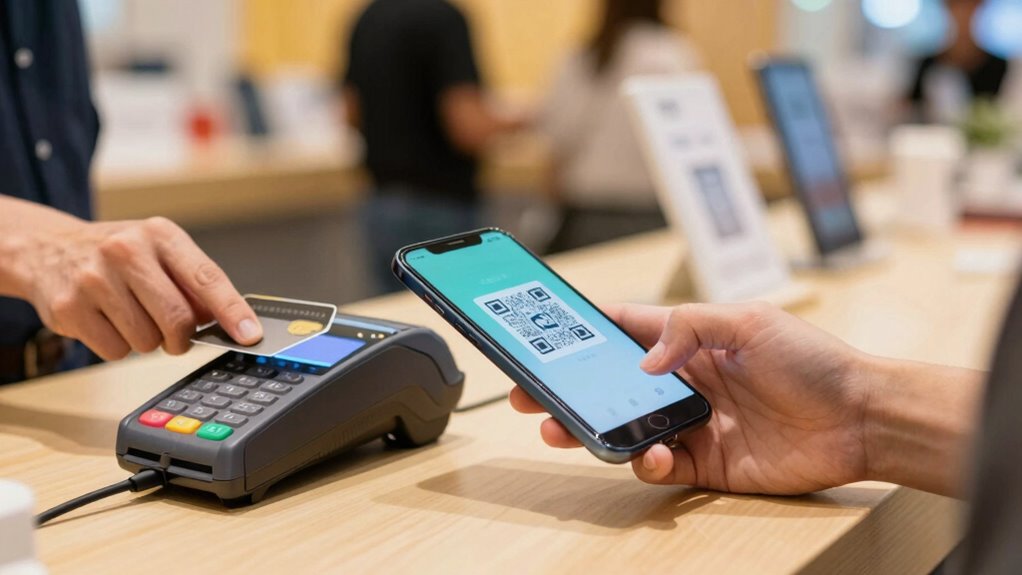
In today’s fast-paced world, consumers increasingly prefer quick and seamless payment methods, prompting retailers to explore alternatives to traditional card transactions. One popular option is QR checkout flows, which streamline the payment process by allowing you to scan a QR code with your smartphone. Unlike traditional card payments that require inserting or swiping a card, QR payments eliminate the need for physical contact with payment terminals. This not only speeds up the checkout but also reduces the risk of card skimming or data theft. As a result, contactless payments like QR codes are gaining popularity, especially in environments where speed and hygiene are priorities.
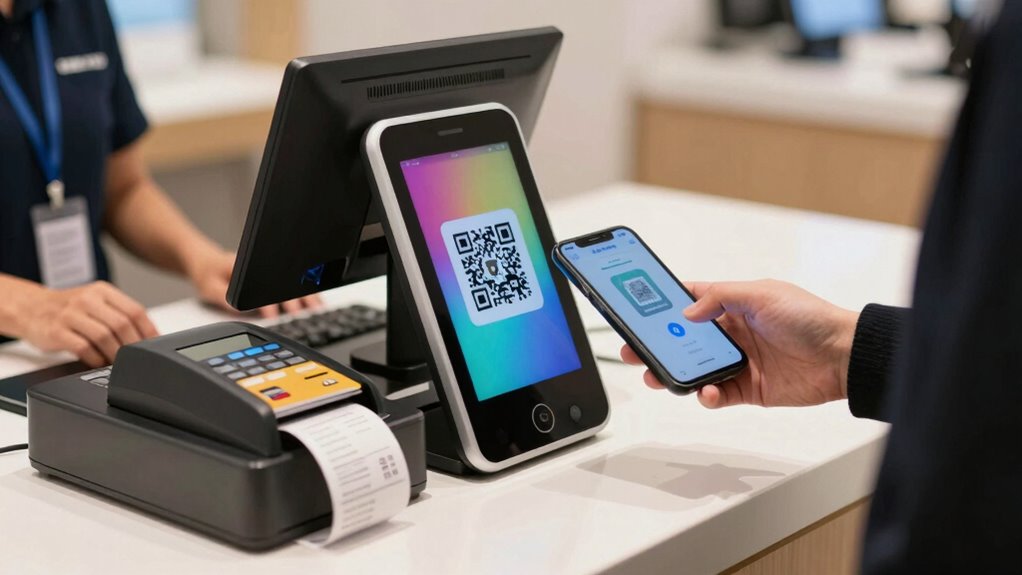
QR checkout flows differ notably from traditional card transactions in how you initiate and complete payments. With a QR system, you typically open a banking or payment app, scan a displayed code, and confirm the transaction—all within seconds. In contrast, traditional card payments involve inserting or swiping your card, entering a PIN, or signing a receipt. The QR process is more straightforward, often requiring fewer steps, which enhances convenience and reduces wait times. Additionally, many QR payment platforms support one-click payments or stored credentials, making repeat transactions even faster.
QR payments are faster and simpler, requiring just a scan and confirmation, unlike traditional card transactions.
Security enhancements are a key advantage of QR checkout flows over traditional card methods. When you use a QR code, sensitive card details are not transmitted directly during the transaction, reducing the risk of interception or skimming. Instead, the payment is encrypted and processed through secure servers, often with tokenization that masks your actual data. moreover, since you scan a unique code for each transaction, the risk of fraud is minimized because the code is often time-sensitive or single-use. Many QR payment systems also incorporate biometric authentication, such as fingerprint or facial recognition, adding an extra layer of security that isn’t always present with traditional card payments.
Another notable difference is the level of control and transparency you have during the transaction. With QR codes, you often see detailed payment summaries or options to split bills, making the process more transparent and user-friendly. Traditional card payments rely on physical cards and manual entry, which can sometimes lead to errors or disputes. QR checkout flows also lend themselves better to digital record-keeping, giving you easy access to transaction histories and receipts stored within your app or digital wallet.

Eyoyo EYH2 Handheld USB Wired 2D 1D Barcode Scanner for POS Mobile Payment
- All-Day Continuous Use: Reduces downtime and boosts productivity
- Plug and Play Connectivity: No drivers needed; compatible with multiple OS
- Supports Multiple Barcodes: Reads 1D and 2D barcode types
As an affiliate, we earn on qualifying purchases.
As an affiliate, we earn on qualifying purchases.
Frequently Asked Questions
How Secure Are QR Code Transactions Compared to Card Payments?
QR code transactions are quite secure because they use data encryption to protect your information during transfer. Plus, user authentication steps, like scanning a code or entering a PIN, add extra layers of security. While no payment method is completely risk-free, these measures make QR payments comparable to card transactions in safety. Just make certain you’re using trusted apps and avoiding public Wi-Fi to keep your transactions secure.
Can QR Checkout Be Integrated With Existing POS Systems Easily?
Imagine fitting a new puzzle piece into your existing setup — that’s how seamlessly QR checkout integrates with your POS system. You can easily connect it through mobile integration, making setup smooth and straightforward. This enhances user experience, allowing customers to pay quickly without disrupting your current workflow. With minimal fuss and maximum efficiency, QR checkout becomes an effortless extension, like adding a new brushstroke to your payment landscape.
What Are the Cost Differences Between QR and Traditional Card Processing?
You’ll find that QR checkout often has lower transaction fees compared to traditional card processing, leading to cost savings. While card transactions typically involve higher fees from card networks and banks, QR payments usually bypass some of these costs, reducing overall expenses. This means you can save money on each transaction, making QR checkout a more economical option for your business, especially with high-volume sales.
How Do QR Checkout Flows Handle Refunds and Chargebacks?
When it comes to refunds and chargebacks, QR checkout flows rely on digital verification to guarantee authenticity and prevent fraud. If a refund is needed, you typically initiate it through the app or platform, which then updates the transaction securely. Fraud prevention measures help handle disputes smoothly, making the process more seamless. While different from traditional methods, these flows aim to protect you and your customers, maintaining trust and security.
Are QR Code Payments Suitable for High-Value Transactions?
QR code payments can be suitable for high-value transactions if you guarantee proper security measures. With digital wallet integration, you get added layers of protection, like authentication steps that enhance user experience. However, you should consider transaction limits and the merchant’s policies, as some systems may restrict high-value purchases. Overall, when implemented securely, QR code payments offer a convenient and efficient option for larger transactions.

Square Terminal – Credit Card Machine to Accept All Payments | Mobile POS
- All-in-One Payment Device: Accept payments, print receipts, and ring sales
- Universal Card Acceptance: Accept all major credit and debit cards
- Fast Chip Card Processing: Process chip cards in two seconds
As an affiliate, we earn on qualifying purchases.
As an affiliate, we earn on qualifying purchases.
Conclusion
Think of QR checkout flows like a quick tap on a magic mirror, instantly connecting you to your purchase without fumbling for cards. Unlike traditional card transactions, which can feel like steering through a maze of swipes and signatures, QR codes streamline the process, making it faster and more frictionless. Just last week, I scanned a QR at a food stall, and in seconds, my snack was paid for—proof that this new flow is truly a game-changer.

Fido Certified Fingerprint Device for Web Accounts Access and Touch-Sensitive Light Feature Computer Fingerprint Reader USB Button Passwordless Login Security
- Controlled Breathing Light: Adjustable breathing light for eye comfort
- Secure Tap Hook: Instantly connect to your computer for security
- FIDO Certified Security: Supports FIDO U2F/FIDO2 for 2FA authentication
As an affiliate, we earn on qualifying purchases.
As an affiliate, we earn on qualifying purchases.
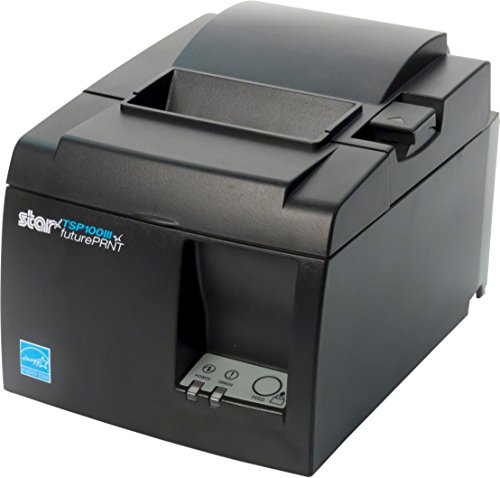
Star Micronics TSP143IIIU USB Thermal Receipt Printer with Device and Mfi USB Ports, Auto-cutter, and Internal Power Supply – Gray
- High-Speed Printing: Prints 43 receipts per minute
- Easy USB Setup: Plug and print with USB connection
- Universal Compatibility: Works with iOS, Android, Windows
As an affiliate, we earn on qualifying purchases.
As an affiliate, we earn on qualifying purchases.